Sunday, January 26, 2020

Entrance into the Story-World: An example

“In books I have traveled, not only to other worlds, but into my own. I learned who I was and who I wanted to be, what I might aspire to, and what I might dare to dream about my world and myself. More powerfully and persuasively than from the ‘shalt nots’ of the Ten Commandments, I learned the difference between good and evil, right and wrong. One of my favorite childhood books, A Wrinkle in Time, described that evil, that wrong, existing in a different dimension from our own. But I felt that I, too, existed much of the time in a different dimension from everyone else I knew. There was waking, and there was sleeping. And then there were books, a kind of parallel universe in which anything might happen and frequently did, a universe in which I might be a newcomer but was never really a stranger. My real, true world. My perfect island.”
-Anna Quindlen, 'How Reading Changed My Life.'
This relates the powerful impact of fiction on the imagination and heart of the reader. It illustrates the phenomenon of entering a story-world via imagination, which world affects the entrant as surely as the world from which he came.
The Ten Commandments and derivative principles should not be replaced by the good lessons from fiction (novels, short stories, plays, etc), but such fiction does serve to offer them up in ways that are quite influential and inspirational. Caution is due, however, as that fiction must be informed not from human imagination and social mores as though they are autonomous, but from an imagination and culture that is imbued with and acquiescent to the revelation of God through the scriptures.

Friday, May 18, 2018

The Gospel and the Fairy Tale


Frederick Buechner wrote an essay entitled, The Gospel as Fairy Tale. [1] Buechner was a Pulitzer Prize nominee, a Princeton graduate, and holder of the Bachelor of Divinity (nowadays, Master of Divinity) from Union Theological Seminary among whose esteemed faculty were Paul Tillich (existentialism), Reinhold Niebuhr (neo-orthodoxy), and James Muilenberg (Old Testament rhetorical criticism). Please note I have little to no sympathy for their theology. In his essay, Buechner does not define what the Gospel is. The redemptive element that the reformed theologian ascribes to the gospel is clearly missing.

Buechner draws from L. Frank Baum's, The Wizard of Oz, a picture of how things supposedly really are. That we all - like the scarecrow, tin woodman, cowardly lion, and even Dorothy herself (in her shoes) - think that we are helpless and incapable of gaining our deepest desire or most urgent need except through the magical help of the Great Wizard, only to find out he's a fraud and that, all along, we had in ourselves the stuff to do it.

Buechner writes of Baum's fantasy:

"The book was published in 1900, and maybe it is not stretching things too far to say that in a way it foreshadows something of what became of the fairy tale of the Gospel in the century it ushered in. The magic and the mystery fade. Like the Emerald City, the city whose gates are pearl and whose walls are adorned with jasper and onyx and sapphire turns out to be too good to be true for all except those who see it through stained glass; and just as for Dorothy home is finally not the Land of Oz, where all things are possible, but Kansas, where never yet has a camel managed to squeeze through the eye of a needle, so for us home is not that country that Gideon and Barak, Samson and Jeptha, glimpsed from afar, but rather just home, just here, where there are few surprises. As for the one who promises to save the world, he is in the richest sense a good man to be sure, but like the little bald man behind the screen, when you come right down to it [he is] not all that much of a wizard. His goodness, his love, his simple eloquence, touch our hearts and illuminate our darkness across the centuries, but for all of that, both we and our world remain basically untransformed. Though he is wizard enough to set us dreaming sometimes of a world of joy more poignant than grief, we tend to believe in our hearts, that, however holy and precious, it is only a dream" (The Christian Imagination, 333-334).

If I understand Buechner, he implies that the myth and make believe of the Wizard of Oz, in particular, and by broad extension, the Fairy Tale in general, has a debilitating influence on how one may perceive the gospel, even tempting one to treat it as belonging to the same level of absurd, even mythical or fantastical, reality. As such, the sacred words of the sacred Wizard turn out to be hollow, and their promises, wishful thinking.

This disparages the gospel. Perhaps Baum was indeed trying to make the point that we can do what needs to be done on our own without the help of the extraordinary and magical. Even so, to place gospel under the same construct, as Buechner does and the way he does, is entirely unwarranted and demeaning. It betrays a very low view of the book that reveals it and misconstrues the person and work of its central figure, Jesus Christ.

That aside, if it were Baum's intention to make the point that we actually do have great potential ability, and we do not really need help from an other-worldly figure, he succeeds. He does so in a way that he may not have in any other genre for children. The fairy tale has its advantages. It can be a vehicle of great ideas (however right or wrong they may be). It captures the child's imagination in a way that the mundane does not. If I may slightly twist a threadbare witticism - it paints truths in pictures, albeit fantastical, that speak louder than the words of a story set in this humdrum world.

Obviously, I am critiquing Buechner from a conservative theological point of view. However, as a writer of Christian fantasy, neither can I let Baum slip away easily. While Buechner demeans and reinterprets the gospel, Baum ignores it because there is no sense at all that the scarecrow's brains, the tin woodman's sensitive heart, the lion's courage, and Dorothy's magical shoes are the result of common grace and providence. This is not to say that every tale of fantasy must be written from a conservative biblical worldview, but it is to say that without writing from that perspective, the truth can be marred or incomplete.

The author of a truly Christian fantasy-world, whether it be a retelling of a classic such as Beauty and the Beast, Cinderella, or the Frog and the Prince, or whether it be a tale that has not yet been told, must redeem the genre for the sake of the kingdom and the glory of God. As such, it must reflect truth as it really is, as God tells us what it is.

[1] Appearing in The Christian Imagination, ed. by Leland Ryken.

Sunday, December 6, 2015

The Shock of Night, by Patrick W. Carr.

  This is the first book of The Darkwater Saga, whose medieval setting is in the twentieth year of King Laidir’s reign. The key figure is Willet Dura raised to minor nobility by Laidir, King of Collum whose citadel is Brunard. Dura served as the king’s reeve and the story begins as he is summoned to investigate the brutal murder of Robin, a guard whose keep was Elwin, a member of one of the religious orders known as the Servants. In an attempt to glean information from Elwin who survived the attack, the Servant pronounces “Domere” upon Dura and expires. From that moment on, Willet Dura is able to delve the minds of all those whom he touches.
  The story unfolds in a tale of Dura’s encounters with the rest of the higher nobles who despise him, a mysterious group known as the Vigil, the four religious orders (Servants, Vanguard, Clast, and Absold), and the menace of Laewan whose minions are those who were once lured into the Darkwater Forest to become his blind followers.
  Willet Dura himself is a survivor of the Darkwater - in a past war, he led a band of warriors into the dreaded forest as a matter of survival against an overwhelming enemy; only Dura escapes, the details of which he is not able to recall and marks him as mysterious and dangerous.
  The singular bright spot in his dismal existence is his betrothed, Lady Gael, with whom he shares an indomitable love. Yet, the prospect of their marriage is increasingly threatened.
  Dura continues his investigation and slowly discovers that there are as many who seek his death as those who are sworn to protect him. As his inquiry becomes more involved, he unearths a plot that threatens the survival of kingdoms and all that he holds dear.

  I grant that the story itself is intriguing and goes a long way in sustaining one’s interest. However, I am quite distraught. One might take issue with its anemic theological world-view (there is an obvious Trinitarian Godhead that corresponds to the Three Persons of the Christian faith) in which little of redemption in this present evil world is artistically dealt with. But that is not what disturbs me. It is the writing itself.
  When I first considered reviewing this novel, I read cursory samplings of some of Carr’s other works, which seemed to hold promise. But I found the writing in this novel to be extremely disappointing. I suspect there are few on this tour, if any, who would agree with me, or at least not to the same extent.

  There is a constant commentary whose purpose, I guess, is to bring the characters to life, but I found to be unrealistic and very distracting. The relentless narrative of body language and facial expressions was simply overbearing: shrugging shoulders, furrowed brows, lips thin, lips tighten, lips quiver, gazes go flat, blossoming anger, blossoming heat, arched eye brows, bile in the throat, chewing the inside of cheeks, faces knotting, standing on the balls of feet, etc. Combined with this were silly metaphors. I catalogued a list of examples, which could have easily been extended. Here are some of them:

p. 46, Invisible hands reached inside my gut and started kneading my stomach like dough.
p. 77, He scowled down at me, his brows meeting over his hooked nose.
p. 77, He spat and growled a curse that could have stripped paint from wood.
p. 78, I gnawed on the inside of my cheek.
p. 112, I felt a trickle of sweat begin to trace an icy path down my spine.
p. 114, My stomach, still queasy, started tumbling in my gut, like an acrobat but not nearly as graceful.
p. 160, His voice rose as the rage trapped behind his eyes broke free.
p. 167, A network of wrinkles radiated out from her mouth, a tight circle at the center of a spider’s web that communicated anger and fear.
p. 170, I could feel the tension in my throat, like lute strings tightened to the breaking point.
p. 172, Uncertainty drained from her like water through the sluice of a dam.
p. 172, She smiled, but her lips imitated the quiver in her fingers.
p. 174, A tremor began in the outer two fingers of his right hand, working its way up his arm until Gael nudged me.
p. 179, A distant rumble of thunder rolled across my hearing like a drummer’s knell before an execution.
p. 206, My stomach collapsed into a hole in my middle, pulling my breath and heartbeat with it.
p. 228, He could feel his eyes trying to start from his head.
p. 232, Cold like the point of a dagger in winter, traced its way through my middle.
p. 238, Anger welled up through my middle, spreading to my arms and legs until the chill from the air faded and my face burned with shame and anger.
p. 260, His eyebrow, as thick over his nose as it was over his eyes, lowered some more.
p. 262, Her brows made half circles over her dark brown eyes.
p. 284, I shook myself like a dog in the rain and stepped behind the barrel.
p. 297, Fear ripped through me like the disturbance of a pebble dropped in a reflecting pool…
p. 309, Her brow lowered, and a vertical line appeared between her eyes.
p. 384, I smiled, forcing my face to don an expression that belied the fear churning in my gut.
p. 399, He eyed Bolt, his dark eyes squinting until they almost disappeared.
p. 401, A giant hand had hollowed out my middle leaving naught but a shell of skin and bones. Spots swam in front of my eyes.
p. 402, Bile built at the back of my throat as more puzzle pieces slipped into place.

Nothing like this is found in the Christian writing that is worthy of emulation (C. S. Lewis, J. R. R. Tolkien, Andrew Peterson). Perhaps this is what is being taught at our Christian Writer’s conventions or approved by editors of Christian Fantasy. I hope not.

I received a review copy  from BethanyHouse for this blog tour.

Amazon The Shock Of Night
Author Website

Participant's list:

Thomas Clayton Booher
Keanan Brand
Beckie Burnham
Carol Bruce Collett
Carol Gehringer
Victor Gentile
Rani Grant
Rebekah Gyger
Bruce Hennigan
Janeen Ippolito
Carol Keen
Rebekah Loper
Jennette Mbewe
Shannon McDermott
Meagan @ Blooming with Books
Rebecca LuElla Miller
Joan Nienhuis
Nissa
Audrey Sauble
Chawna Schroeder
Jessica Thomas
Robert Treskillard
Shane Werlinger
Phyllis Wheeler
Nicole White

Monday, September 21, 2015

September 2015, Christian Fiction and Fantasy Blog Tour


The First Principle, by Marissa Shrock.

After  the Great Collapse and the Second Civil War, the geographical and polical makeup of Canada, Mexico, and the United States was reformed by the Council of World Peacekeepers into the United Regions of North America. Governor Wilkins of the The Great Lakes Regions is about to be nominated for the presidency of URNA, when Vivica, her daughter finds out that she’s pregnant. Term law requires that she abort the child, which Vivica has no problem doing. But she begins to have second thoughts when she is challenged by her boyfriend and father of  the child, Ben to keep the baby. Ben is a Chrisitian, who acknowledges his sin and seeks to make things right between him and Vivica and the baby she is carrying. Keeping the baby would not be an easy task as teen girls are constantly monitored. However, Vivica does have a knack for hacking into networks and modifying information, a skill that has been financially rewarded by those whose school grades were in need of adjustment. She’s able to keep her pregancy test results negative, but she is up against the clock as time is obviously going to reveal something that no hacking skill is going to be able to amend.

Ben’s Christianity is an offense to Vivica, but her continued interest in him, and an almost unwilling acknowledgement of a commitment to protect her baby, keeps her from rejecting it outright. To make matters more complicated, Ben is part of the rebel contingent that is gaining in strength; any commitment to him is to place Vivica in opposition to her mother and the whole naturalist philosophy that dominates the political and social structure of URNA.

Marissa Shrock has written a tale that takes current-day issues and injects them into a future that is teetering between dystopia and eutopia. Vivica has to make some hard choices, any of which is going to place her in opposition to family or friend.

The story is fairly well-written, though there is one thing that I find very annoying – free indirect speech. An occasional use is acceptable, but a steady diet can become very irritating. I do not doubt that I am in the minority on this, but I think it is a cheap, colorless way to peek into someone’s mind and see what is going on. Overlooking that, I am quite pleased with Ms Shrock’s writing.

I suspect that the strong, and at times tract-like (though artful), presentation of Christianity might be a source of consternation for some, but frankly, I think it has its place in Christian literature. If the purpose of a story is to present the Christian faith in a straightforward, head-on manner, The First Principle fills the bill. I suspect that is at least part of what the author had in mind. In concert with that was the subtle and sometimes not so subtle encapsulation of the social issues of today – teen pregnancy, abortion, rationale for abortion, the anti-intellectual charge against Chrisitianity, etc. Some of it may come across as stereotypical and might detract from the story, but regardless, the issues are laid out for the reader. For those who are familiar with them already, they might find the novel one-dimensional. But for the world of teens in which not much thought has been given to the issues, or in which the party-line has been uncritically swallowed, this story is precisely what is needed, and it is in that I find its greatest value.

Not only that, but it was very entertaining. An enjoyable read that I have no problem recommending.

am very grateful to Kregal Publications which provided a copy for this review for the September, 2015 Christian Fantasy and Fiction Blog Tour.

Blog Tour Participant Links:

Julie Bihn
Thomas Clayton Booher
Beckie Burnham
April Erwin
Victor Gentile
Carol Keen
Shannon McDermott
Meagan @ Blooming with Books
Megan @ Hardcover Feedback 
Rebecca LuElla Miller
Joan Nienhuis
Nissa
Jalynn Patterson
Chawna Schroeder
Jessica Thomas

Monday, December 15, 2014

November/December 2014, CSFF Blog Tour - The Fatal Tree, by Stephen Lawhead

Stephen Lawhead brings his Bright Empires series to a close in the fifth installment, The Fatal Tree. A lot was going on in the first four books and if asked if everything came to a satisfying conclusion, I would say, 'Mmmmm, I guess so.' The End of Everything is reversed, the cast of characters more or less have settled into a happy state of affairs, even as some of those have taken an unexpected turn.

Foremost in mind is Lord Archelaus Burleigh, fiend par excellence who has been converted. Converted? Can we say that he was actually converted? I guess we can; that is, after all, the language used in the tale. And indeed there is a change with Burleigh, a very radical one at that. Since change is at the heart of conversion of any kind, I guess we can agree that such a word can be applied to the character.

However, I do have some serious questions about Burleigh's change of heart. The context of the conversion is the backdrop of the exemplary behavior of Etzel (the business partner and friend of Mina) who is a devout Catholic with a seemingly genuine sense of what it is to imitate Christ, and it is that relentless behavior that wore on Burleigh breaking down all barriers. As a side note, I want to give Etzel the benefit of the doubt, that his character and behavior are based on real New Testament conversion through faith in Christ alone as Lord and Savior without the need for meritorious works (in which case, he is a New Testament convert in spite of his Catholic doctrine which holds to conversion/justification through faith plus works). As a Calvinist, I must make the point, seeing that our theology cannot help but color our story-making, and we all hope our story is good because our theology is good. If not, I wonder how we can still call our writing at its very heart, Christian writing.

Given that context, Burleigh seemed to have undergone some deep seated conviction. His eyes were opened to his nefarious state, and he is so overwhelmed him that his only recourse (as he saw it) was to change and seek whatever means to undo all the wrong he had done. That does lead to a near disastrous miscue on his part that came out of intentions that were noble (I think), and that seemed to be enough for Kit to suddenly have some pity for the man (p 324).

My complaint is a Calvinistic one. Conversion is a work of God in the heart in which God produces a conviction of sin, righteousness, and judgment (John 16:8). Without such conviction there is no true repentance toward God and faith toward Christ (Acts 20:21). Burleigh's remorse is over his behavior of the past and the despicable results of that behavior, but it does not come across that he sees himself as a sinner in need of a Savior from that sin. He feels the need to make up for his wrongdoings rather than recognize there is nothing he can do to make up for them and that another must atone for them if he is to have any hope of forgiveness and cleansing.

I know, The Fatal Tree is a work of fantasy, but it is advertised as a Christian work of fantasy. Where is the gospel - the real gospel that you find in Paul whose desire was to boast in nothing but the cross of Christ by whom the world was crucified to him, and him to the world? Who insisted that it is not through keeping the law that one is justified before God (Rom 3:20), but through faith in Christ (Rom 3:22), and that law keeping is a result of salvation rather than the basis of it (Eph 2:10)? Burleigh's behavior does not look like repentance and faith as much as his seeking to fix things for the mess he has made.

The usual objection to this kind of inclusion of the gospel in a novel is that the story will become preachy or soppy or pedantic or confined. It's audience will be limited, and its prospect for publication by a respectable publishing house severely limited. 

Well, I would grant the latter although Thomas Nelson is no mean publishing house, and if the gospel were present in the Bright Empires series as I would like to see it, such a publishing house would not for that reason alone turn Lawhead away provided he applied his fabulous writing with a view to work out the gospel at the appropriate places (such as the conversion of Burleigh).

I must say this, that Mr. Lawhead's development of the inner struggle of Burleigh over Etzel's kindness was brilliant. There was nothing artificial in it, or soppy, or preachy, or pedantic. It was simply a magnificent portrait. My point is the same can be done with the gospel where sin, repentance, and faith in Jesus Christ as Lord and Savior can come through explicitly, genuinely, and naturally. I think that often the offense taken with Christian fiction (such as you see in Amazon reviews) has as much to do (if not more so) with the writing as with the message.

This was the final book in the saga. Did it have a satisfying conclusion? Did it draw all the strands together and bring a closure to the tale? Yes and no. We see what the end of the story is for all of the main characters, but I am a little bewildered. Foremost in my mind is Lady Fayth and Giles who are stranded in a time and place from which there will be no way out. They have only each other and there is the happy conclusion of their discovery of mutual love and resulting marriage. If these two meant anything to the reader, the reader began to root for their romance at some point in an earlier book in the series. But if you were like me, you also expected them to have a significant involvement in the final resolution of things. That they did not was disappointing to me.

I would not hesitate to recommend the Bright Empires series to anyone but would caution that the tale is quite convoluted. Nevertheless, if one bears with it, the complexity actually adds to the quality rather than detracts, and provides ample opportunity for the imagination to romp like a child in an amusement park.


In conjunction with the CSFF Blog Tour, I received a free copy of this book from the publisher. 

The Fatal Tree (Amazon)
Steven Lawhead's Website
Steven Lawhead's Facebook page

Wednesday, August 27, 2014

Merlin's Nightmare by Robert Treskillard, CSFF Blog Tour (August 2014)

Overall evaluation: I recommend the whole Merlin series for young readers, especially those who are fond of Arthurian legend. They would not be disappointed.

I regret that I have not been able to finish Merlin's Nightmare in time for this blog tour, having read only half of it. However, I do wish to make some general remarks.

Without question, the tale is very good. Lots of things going on without any of it feeling out of place or extraneous. So far, the shift of focus is from Merlin to Arthur (Artorius), which had to come sooner or later. It should lead to Arthurian sequels with Merlin still in the picture but likely taking a less important or less prominent role (which is sad - as I found the transition from Bilbo to Frodo).

As a novel for young fantasy readers, the writing is probably appropriate. I have enjoyed everything I've read thus far. The battle in the south and the killing of Horsa by Arthur would wrest the imagination of most young readers, though I did find Arthur's removal of his boots in the heat of battle with a chariot and foot soldiers almost on top of him a little far-fetched (unless they were slip-ons, you just wouldn't have time to do such a thing). The story is a bit gory at times, but not so graphic that it is offensive - at least for me.

Morgana and the Voice come across in a very menacing, dark way; the transformation of Ganeida (Merlin's half sister) into Morgana has been developed quite well through the series. The despicable Vortigern, at least in the first half of the book, seems to be more down to earth. Not that he has become a likable fellow by any means, but you see a side of him that is less monstrous than what we've seen in the previous volumes. At the same time, Vortigern's capricious attitude toward the Saxenow is setting up for what might become a climactic conflict between him and Arthur.

The Picti of the north are an ominous threat, and Merlin, though he has been drawn away to the south with Arthur, receives puzzling signs of something amiss through the remnant of his wife's (Natlenya) skirt which he has taken as a keepsake. For me, his reaction to these signs (wetness, renting) are quite subdued and therefore unrealistic.

Again, I recommend the series for young fantasy readers.

 In conjunction with the CSFF Blog Tour, I received a free copy of this book from the publisher. 

Friday, July 4, 2014

Glorifying God in the Secular Arts

Luke 15:11 - And he said, “A certain man had two sons. . .

Jesus told stories and by that we conclude that story-telling is a legitimate and noble practice. I recently read an article by one of my Facebook friends (E. Stephen Burnett) the title of which was How to Glorify God with Wizards, Captain America, and Spider-Man. It seems to me this friend has strong leanings toward a reformed perspective (influenced by Abraham Kuyper and Herman Bavinck), and I anticipated a theological defense of what the title intimated. However, he surprised me, and though he indicated that he could provide such a defense, he opted against that and chose rather to show from his own experience how one may glorify God in that way. It was quite intriguing, and I am in full agreement not only with the premise, but also in the way in which he demonstrated it through his life’s experiences rather than a biblical treatment. Here is an example of those experiences:

To this day I can remember Peter Parker in Spider-Man 2’s final battle recalling the truth he had just learned and repeating it to a remorseful Dr. Octavius: “Sometimes to do what’s right, we need to be steady and give up the things we want the most — even our dreams.”
I can’t always say how, but that truth imaged by a fictional hero has aided my spiritual “revival” for years. I followed Spidey’s web all the way to the true story — God’s story — of the Hero who surrendered Himself to help people become the heroes they should be. To this day, I can credit the original Spider-Man films for helping save my marriage before it even began.

I was a little hesitant to present this example lest it be misunderstood that my friend’s theology saw Christ’s heroism at the cross as only an example by which others may become heroes as well. I know that is not the case, but it underscores a problem that is inherent with fictional heroes invented by the secular mind. They are horizontally oriented rather than vertically. They do not take their starting point in the biblical world and life view, but from the one which man devises out of his own resources, which are actually borrowed from God. As a result, though the hero may be powerfully inspiring and noble, and though he may illustrate to some measure what we find to be true from a biblical perspective, it is dubious at best. Not merely because of the finitude of the secular creator, but because of the tendency of such a one to create something that tends to exalt the creature rather than the Creator (cf Rom 1:25).
Spidey’s epiphany of the truth in Spider Man 2 is a powerful challenge to the movie-goer in the context of Dr. Octavius’s relentless and unmercifully violent drive to complete his dream at all costs. Even so, Spider-Man 3, in my opinion, is even more potent as it portrays the virtue of forgiveness in an evocative, nearly tear-jerking manner. How is it that a story written from an unbiblical world-view, whose setting itself is atheological (people live and work as though there is no God, regardless of any professed beliefs in the existence of God) can include such noble ideas?
The overarching answer is what theologians call common grace. It is grace that God has bestowed on all men alike, regardless of their relationship to him. Louis Berkhof explains that "[common grace] curbs the destructive power of sin, maintains in a measure the moral order of the universe, thus making an orderly life possible, distributes in varying degrees gifts and talents among men, promotes the development of science and art, and showers untold blessings upon the children of men.”[1]
Wizards, Captain America, and Spider-man are fantasy characters representative of a special type of literary art, and, as Berkhof noted, the ability to produce such art is a result of the distribtution of God’s gifts among men. These are gifts for which all should give God the honor, yet the unbelieving sinner can do so only in a superficial way because he does not know God through a faith in Jesus Christ resulting in a renewed mind and enlightened heart (Rom 12:2; 2 Cor 4:6; Eph 1:18; 4:23; Col 3:10). He may sense that there is a Higher Being who is responsible for his artistic greatness, and acknowledge that, but he does not sense that he should love that Higher Being with all of his heart, soul, mind, and strength (Luke 10:27). The gifted secular literary artist writes about what he knows to be true of right and wrong (Rom 2:14-15), but does not really know why it is true. He just knows it. He knows there is good and evil, and his God-given literary skill enables him to write in such wonderful imagery that these truths can come across very powerfully. And yet, unless the truths of his novel or screenplay or poetry are overtly grounded in the gospel, though they may persuade some, even unbelieving sinners, to outwardly alter their behavior in one degreee or another, they cannot transform from the inside out. Such stories may inhibit sinful behavior, but they cannot free from sin because there is no gospel in them. Their usefulness for true spiritual growth is profitable only for the Christian who recognizes the virtues as beliefs and behavior that are the result of a new birth which changes the heart (cf 2 Cor 5:17; Eph 4:24; Col 3:10) and for that reason he works them out in his life because he knows that it is God that works in him to do his good will (Phil 2:12-13).
How can secular man write such stories? It is because he is in touch with the predicament of this world and himself though he is not in touch with Creator of the world through his Son. Secular man is not unintelligent. He can observe and analyze. His sinfulness does not inhibit that, as intelligence is one of those gifts God disperses commonly among human beings. His observations and analysis are influenced by another common grace, which is the law written on the heart (Rom 2:14-15). He cannot help but sense the right and wrong in this world and judge it to be truly that, good and evil. There is no man-made story, tragedy or comedy, which is not shaped by the overall character of this present age – the conflict between good and evil (cf Gal 1:4; Rev 19:11-21). And though it provides opportunity for the secular man to put his twist on the true, the good, and the beautiful, it is only the Christian who can listen to it and discern the truths that underlie the story-world. As such, there is a legitimate place for the Christian not only to attend such movies as my friend alludes to, or read the stories that such movies are based on, but to carefully think about them and see what is in them that may help him, in light of God’s word, live up to the true gospel standard.


[1] L. Berkhof, Systematic Theology, Wm. B. Eerdmans, Grand Rapids, 1939. p 434.

Tuesday, March 18, 2014

Francis Schaeffer Perspective #6 - Art Form's Versatility in Message Types


Perspective #6: Art forms can be used for any type of message from pure fantasy to detailed history.

If we recall the discussion in Perspective #1, Schaeffer ruled out the nature of art as exclusively an embodiment of a message. Rather, he contends, the art communicates the world-view of the artist. In that perspective, a message seems much less important than the aesthetic value or its ‘work-of-artness.’ But now, the usefulness of art as a communicator of a message comes to the fore. I don’t think this is a shift in his thinking, but simply coming around to what he tended to deemphasize (but not dismiss) in the earlier perspective.

Schaeffer recognizes that art does communicate a message. The question that I raise is what is the relation between the art and the message? Does the aesthetic value of art have the priority over the message it communicates? Schaeffer seems to think so (Perspective #1). The answer to that question controls what subject the artist focuses on, and how his artwork portrays that subject. If message has priority, an artist is going to be careful, perhaps in a tedious way, of not only what the subject is, but the way it is dealt with. If the art has the priority, the artist will probably do his work more through whim and fancy and self-gratification.

When we stand in front of any painting, we naturally look for something that is recognizable. When we stand in front of some paintings, we are initially struck by the craftsmanship of the work. The more exquisite the art, the more we are caught up in its beauty. We are initially not looking for a message. In other paintings, the art may be exquisite, but its message so powerfully obvious, that the message takes the prominence. In still other paintings, the art and the message seem to hit the viewer at the same time with equal force.

Consider Emanuel Leutze’s 1851 oil painting, Washington Crossing the Delaware. The artwork is top-notch, and its beauty and magnificence delights the eye. At the same time, one is equally struck by the drama of the moment as he beholds a confident, stoic Washington[1] at the head of the force. It conveys the character and emotion of the General at what was probably the darkest hour of the American Revolution. It undoubtedly depicted Washington as he was perceived by both soldier and citizen. Washington is at least part of the message, and it comes clearly across to the viewer. The technical quality is superb reinforcing the message. The message is there in all of its beauty because of the artwork. Both art and message have an equal impact. If there is a message in art, the profundity, clarity, and coherency of that message is dependent on the profundity, clarity, and coherency of the artwork itself. I think we can say the reverse is true as well.

For writers of Christian fiction and fantasy, the priority between the art and the message, and what mutual affect there is between the message and the art of our writing is not a small matter. It will control what we write about and how we write it. The gospel is a profound message, going deeper than any mystery of science and nature. The gospel is a wondrous message, soaring higher than any marvel the modern academician stands in awe of. If our writing is truly Christian, it should not be based on crass whim and fancy, and certainly not self-gratification (it's a feel-good story). It should plumb the gospel’s depths and reach for its stars. As for the writing itself – the author should strive to write as profoundly and as beautifully as the message. One does not offer a gem of great worth in a shoe box.

In a loose way, whim and fancy cannot help but appear in Christian fantasy if we think of it as pulling things out of the imagination that have no definable existence in reality. But it is not willy-nilly. There is care for what might show up in our writing, and diligent attention to the message behind the 'whim and fancy' of our imagination assures a fitting place for it in our story. Andrew Peterson's toothy cows add a delightful twist to his tale. Taking what is ordinarily an amiable figure in the young child's mind, he turns the friendly into the frightening by simply adding a slight deviation (the toothiness). The presence of the toothy cows adds another element of danger to an increasingly precarious adventure. It does that potently because it connects so well with the young reader. It faces a more stringent test - the adult reader. I think it will pass. I suspect it will evoke long forgotten impressions of his youthful imagination. It did for me.


[1] Undoubtedly, Washington had a stolid temperament that inspired confidence of those under him. Yet early on there were many who quit the war, so to speak, when their enlistments were up. They took their government issued rifles with them. When Washington met with his officers to go over the final details of the crossing on Christmas Eve, 1776, he may have exuded confidence, but in private he was not so. David McCullough writes, “Years later, [physician Benjamin] Rush would recall a private meeting with Washington at Buckingham, during which Washington seemed ‘much depressed.’ In ‘affecting terms,’ he described the state of the army. As they talked, Washington kept writing something with his pen on small pieces of paper. When one of them fell to the floor by Rush’s foot, he saw what was written: ‘Victory or Death.’ It was to be the password for the night.” 1776, Simon and Schuster, 2005.

Friday, March 14, 2014

Francis Schaeffer Perspective #5, Four Basic Standards to Apply to a Work of Art

Perspective #5: There are four basic standards that one must apply to a work of art: (a) technical excellence, (b) validity, (c) intellectual content, the world view which comes through, and (d) the integration of content and vehicle.

Schaeffer contends that a great artist should be recognized for his technical excellence regardless of the content or the world-view which comes through. I agree. Schaeffer uses painting to illustrate his meaning: color, form, balance, texture of the paint, the handling of lines, the unity of the canvas. The painting (or any kind of drawing for that matter) has a great many elements that go into its creation. Earlier in the essay, Schaeffer refers to these as symbolic vocabulary in an attempt to show the parallel with literature. This implies that art, whether graphic or literary, has a common vocabulary (as both say something intelligible) which is governed by ‘linguistic’ rules. Through these rules, the speech of art allows the artist to be creative and mimic (as an image bearer) the creativity of God (who spoke the words, “Light be!” and there was light). When we honor the pagan artist for his excellence, we are utltimately honoring the divine image in him and thereby the One after whom the image is patterned.

The potential for technical excellence resides in the secular[1] writer of speculative fiction because that is the way the Creator made him. If a secular writer has reached realms of excellence of which we stand in awe, he should be recognized. We should read his works not only for entertainment, but also that we may learn how to write better. Additionally, if he has written anything on how to write, it would behoove us to make good use of it.[2]

The second criterion, validity, is whether or not the artist is true to himself and his world-view, or whether he is doing his work for the sake of another.  If an artist paints or writes for the sake of a patron (which can be anybody or anything the artists wants to gain the approval of or have access to) his art has no validity.

I have often thought of how writing in a (pulp) art genre which is hugely popular and sells well (Christian Romance, for example; see C. S. Lakin’s post, Genre Versus Author Platform: Which Matters Most) might be a way to gain recognition for one’s real work, reflecting his real writing interests. To do so, according to this criterion, would discredit that work as a work of art. I agree, and if I am a purist about this business of writing, I won’t attempt to do so. Unless, of course, my interest changes which poses the challenge to actually write in a different genre to see if (a) I can actually do it, and (b) I might actually like it – it rings true to me. With regard to the romance novel, I think I am quite sure that neither (a) nor (b) would hold for me. But it may be worth looking into the market to see what sells and whether I might have an affinity for it.

The third criterion, intellectual content, is to assess the world-view that comes through the art. It must be judged in terms of a biblical world-view. A work of art should never be free from the judgment of the Word of God. The logic behind this is sound: if a work of art reflects the artist’s world-view then just as the thinking of all men, great and small, profound or superficial, is judged by God, and all will one day answer to God for their world-view, the art work itself is, therefore, subject to the same kind of judgment. In practice, I’m not quite sure what this means. What does it mean to pass judgment on a work of art? We have already granted the artist his honor if his work is excellent. Does it mean following the praise we deplore it for its message? I think that is allowable, but we must be careful that it does not open the door to defame the excellency of the work and the artist. How much that is possible, I’m not sure. It is certain that open judgment of the work is necessary because, as Schaeffer contends, the richer and greater the work, the more powerful it is in pressing home its message.

This holds true for speculative fiction. Much non-Christian science fiction and fantasy is rooted in evolutionary theory, and it seems easy for the Christian reader to ignore that. I enjoyed Carl Sagan’s novel Contact which is about man’s first detection of extra-terrestrial intelligence through the means advocated by the National Research Council (an electromagnetic signature). The whole premise of SETI (Search for Extra-Terrestrial Intelligence) is based on the high probability that intelligent life could have risen and developed elsewhere in the universe. The Drake Equation used to come up with the number[3] has evolutionary assumptions built into it. As entertaining as Contact was, and as technically appealing as it was, the caveat must be sounded by the Christian reviewer that the world-view that comes through is anti-biblical.

The fourth criterion is how well the artist has suited the vehicle to the message. “For works which are truly great, there is a correlation between the style and content.” As high fantasy, Lord of the Rings was written in a style that fit the epic character of the story. The imaginary world was best portrayed through a sophisticated and lofty literary style. Tolkien spent great detail in describing landscape and terrain, moving the story at its own pace (not rushed, but unfolding slowly like it does in real life), salt-and-peppered with proportionate amounts of royal and common dialogue, great battles, and personal struggles. Much of this had to do with the readership Tolkien had in mind. It was not a children’s fantasy like the Chronicles of Narnia, and though the Narnia stories have a sophistication of their own and are superbly written, they are still a different style.

Much of today’s young adult speculative fiction is written in a style that suits its audience, but it is not very sophisticated and there is little elegance. Instead, there is corniness, cartoonishness, and melodrama. Perhaps the author thinks that is the only thing that will appeal to the younger ones. I ask, so what? Give them something they can look back on in adulthood and see a beauty and elegance that appeals even then. A children’s story should never be outgrown by its readership. C. S. Lewis put it this way, “I am almost inclined to set it up as a canon that a children’s story which is enjoyed only by children is a bad children’s story. The good ones last. A waltz which you can like only when you are waltzing is a bad waltz.”[4] In my opinion, Andrew Peterson’s Wing-feather Saga is the only modern Christian children’s saga that I have read that measures up to this criterion.


[1] I am using secular in a somewhat liberal way to include all who do not embrace Christ as Lord and Savior. Such ones may be theists of the Judeo-Christian tradition, but there is nothing in their claims or behavior to indicate they are of those whose hearts have been changed and are faithful followers of Christ. The world-view that comes through in their writing speaks volumes in this regard.
[2] I recommend Stephen King’s On Writing. I have read others, but I like his best because of the style, and also because I like his dinosaur analogy on how a story develops. One caveat: his language is coarse at times. If you’re looking for a more technical approach with lots of examples from modern day classics, I recommend Structuring Your Novel: From Basic Idea to Finished Manuscript by John D. Fitzgerald (Great Brain series) and Robert C Meredith. Orson Scott Card (Ender’s Game) has written Character and Viewpoint, How to Write Science Fiction and Fantasy, and is a contributor to Complete Guide to Writing Science Fiction: Volume One, First Contact.
[3]  Estimated by Sagan at 1,000,000 in our galaxy when he wrote Broca’s Brain (1974), ten times that now because of an estimated increase in the number of rotating planets around red dwarfs which are deemed to have a higher probability to support life.
[4] C. S. Lewis, “Three Ways of Writing for Children,” in On Stories and Other Essays on Literature, ed. Walter Hooper (New York, NY: Harcourt Brace Janovich, Publishers, 1982), 33.

Tuesday, January 28, 2014

Francis Schaeffer Perspective #4, Art is not Sacred

Perspective #4: The fact that something is a work of art does not make it sacred.

Schaeffer’s point here is that the greatness of the work of art does not validate that world view of the artist. This is a caution against letting the power of the art blind the viewer to any distortion or lack of truthfulness about the way things are as portrayed by the art. I think song can illustrate this point quite well. Song has a powerful impact on the whole makeup of a person. It seems to awaken a sensitivity within the psyche that makes one susceptible to the truth-claims of the song. Song is the combination of musical instrument(s), style, lyrics, and the personal touch of the one(s) who perform. Together, these components can produce something that keeps coming back long after the original hearing of the work. The message of the lyrics play again and again in one’s head, and the music with its melody, harmony, rhythm, and beat reinforces that message. The 1973 rock opera, Jesus Christ Superstar, is a case in point. I have never seen its performance, but I have heard much of the music to know that the Jesus of the opera is a phantom, and a dangerous one who destroys the imagery and truth of the Jesus of the Four Gospels. The tune was catchy and resonated with the lyrics.

Jesus Christ
Jesus Christ
Who are you? What have you sacrificed?
Jesus Christ
Jesus Christ
Who are you? What have you sacrificed?
Jesus Christ
Superstar
Do you think you're what they say you are?
Jesus Christ
Superstar
Do you think you're what they say you are?

Tell me what you think
About your friends at the top
Now who d'you think besides yourself
Was the pick of the crop?
Buddah was he where it's at?
Is he where you are?
Could Muhammmed move a mountain
Or was that just PR?
Did you mean to die like that?
Was that a mistake or
Did you know your messy death
Would be a record breaker?

Contrast that with Man of Sorrows (Philip P. Bliss, 1875):

“Man of Sorrows,” what a name
For the Son of God who came
Ruined sinners to reclaim!
  Hallelujah! what a Savior!

Bearing shame and scoffing rude,
In my place condemned He stood;
Sealed my pardon with His blood;
  Hallelujah! what a Savior!

Guilty, vile, and helpless, we,
Spotless Lamb of God was He;
Full redemption—can it be?
  Hallelujah! what a Savior!

Lifted up was He to die,
“It is finished!” was His cry;
Now in heaven exalted high;
  Hallelujah! what a Savior!

When He comes, our glorious King,
To His kingdom us to bring,
Then anew this song we’ll sing
  Hallelujah! what a Savior!


The psalms and hymns of our Sunday worship are a powerful force, and the church must be ever careful in the theology of its lyrics. There are some hymns, whose theology or egocentricity I find so offensive, I refuse to sing though all others around me participate.

Because the power of the art is so influential in pressing home the world-view it contains, the Christian artist must be careful not to portray inadvertently a perspective that is unbiblical. Christian speculative fiction is especially in danger. Take, for example, a Christ figure. Aslan from the Chronicles of Narnia is such a figure. Is there anything in Aslan’s behavior, speech, mood, or countenance that could portray a Christ that is unbiblical. True, we cannot control the imagination of the reader, but we should take care not to give anything questionable that the imagination can dwell on.


This danger is heightened when the speculative writing is turned into cinema with the wondrous graphics it has today. The imagination is far more passive in taking on the imprint of what is physically seen and heard. That is what I found so disturbing about the Passion of the Christ (2004, directed by Mel Gibson) and it is what I so much appreciated about Ben Hur (1959, directed by William Wyler). In The Passion, the body language, facial expressions, and mood made Christ, the Lamb without blemish, to be no different than any other (sinful) human – there was not the beauty of holiness that marked the Christ of the gospels. In Ben Hur, one never saw the face of Christ. Only once was there a full body shot, and it was from behind when Christ is about to deliver the Sermon on the Mount. A sacred respect about the character and manner of the Messiah was maintained. This is not a small matter when we consider that Christ revealed (exegeted, John 1:18) the Father, and we may assume that he did this in the minutest detail of his speech, facial expressions, and mannerism.

Tuesday, January 21, 2014

Francis Schaeffer's Perspective #3: Continuity with Words and Syntax


Perspective #3. In all forms of writing, both poetry and prose, it makes a tremendous difference whether there is a continuity or a discontinuity with the normal definitions of words in normal syntax. 

In this perspective, Schaeffer uses both literature and painting as examples. It is easier to comprehend his point by first considering a picture. Abstract art will have shapes and colors but does not communicate anything concretely
meaningful. One may look at the art and see something familiar. For example, in this picture, I see a fish feeding. But I also see the mouth and chin of a child; and a giant hair follicle or maybe Larry the Cucumber. In abstract art, one sees intriguing and aesthetically appealing shapes and colors, but they have no meaning except what the observer gives to them, a meaning that comes out of an association between what he sees in the art and what he knows as real and has a meaning which everyone agrees on.

Finnegans Wake, by James Joyce, might be considered abstract art in prose.[1] Jabberwocky, by Lewis Carroll, less so. It is classified as a nonsense poem, but  does have enough sense to it that the killing of a monster is not missed. Its appeal (and clarity also) is heightened when read aloud.
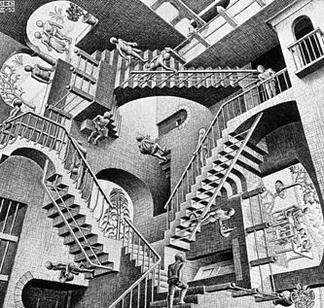
Akin to totally abstract art is art that has identifiable forms in it, but are arranged in such a way that in a casual glance one’s mind does not detect anything amiss; but then, on closer scrutiny, they defy meaning. The graphic art of Maurits Cornelis Escher is an example. In his painting, Relativity (1953), there are a number of stairways and windows that in themselves make perfect sense. But there are people walking up and down them in ways that are impossible and therefore make no sense. For example, the stair at the top of the picture has two persons on it facing the same direction and nearly at the same point, but one is moving up the steps while the other is going down them. We are imaginatively torn as we try to conceive of both true at the same time. We are trying to turn the illogical visuals into something logical, and it gives rise to a frustrating feeling of helplessness because what seems to make sense at first suddenly becomes impossible and thereby has no sense at all. Prose that mimics this kind of art can produce the same frustration.

Schaeffer does not see such art as intrinsically immoral or anti-Christian, but simply that it loses a dimension of communication.[2] Here we are brought back to the point that communication in art is significant, and if so, it increases its value. Communication is important, and it implies a message. It is message that writers of speculative fiction (or any fiction) must give care to. Carelessness or insenstivity in the use of vocabulary, syntax, and grammar will affect the clarity and possibly the meaning of the message. It is not simply words arranged according to rules of grammar and syntax. It is more. Stephen King made the astute observation, “Take any noun. Put it together with any verb, and you have a sentence. It never fails.”[3] The noun and verb follow the rules of grammar and syntax. We may think that all sentences with just a noun and verb say little – except the Johannine observation, Jesus wept. That simple sentence is a jewel whose beauty is magnified by the contextual earth it lies in.

Consider the noun Frog and put it with the verb sings - Frog sings. Does the sentence say something? We know there are no such things as singing frogs, except imaginary ones. A singing frog makes no sense. Are we to say that a story about a singing frog has no value because of the unlikelihood (really, impossibility) of any frog having the ability to sing. Warner Brothers introduced Michigan J Frog in a Looney Tune cartoon on December 31, 1955 entitled, One Froggy Evening
If you’re as old as I am, you likely saw it in its debut. The animated feature was a speculative masterpiece, and it did say something – this world is cursed and our best plans go awry. The humor may have dulled that point, but it was there. A singing frog makes no sense, but a story about a singing frog can make a lot of sense. That is why the Chronicles of Narnia makes sense. Talking beavers are illogical, but they can say things that are profoundly true. Speculative fiction uses the illogical, but it does so in such a way that a message is communicated. Speculative fiction is not abstract art, and it should not be art that frustrates because it is imaginatively perplexing.


[1] “The entire book is written in a largely idiosyncratic language, consisting of a mixture of standard English lexical items and neologistic multilingual puns and portmanteau words, which many critics believe attempts to recreate the experience of sleep and dreams. Owing to the work's expansive linguistic experiments, stream of consciousness writing style, literary allusions, free dream associations, and its abandonment of the conventions of plot and character construction, Finnegans Wake remains largely unread by the general public.” Wikipedia Article, FinnegansWake.


[2] Schaeffer writes, “If there is no continuity with the way in which language is normally used, then there is no way for a reader or an audience to know what the author is saying. . . When, therefore, there is no attempt on the part of an artist to use the symbolic vocabulary at all, then communication is impossible here, too. There is then no way for anyone to know what the artist is saying,” 37-38.


[3] Stephen King, On Writing.