Wednesday, September 21, 2011

CSFF Blog Tour - September 2011, Day Three

Christian Science Fiction and Fantasy Blog Tour (September 2011) - Day Three.

The Monster in the Hollows, by Andrew Peterson.
Day One Post
Day Two Post

In my first post I mentioned that because The Monster in the Hollows was well-written for the middle schooler, it would also be enjoyed by those beyond middle school age, i.e., by young adults and adults. Of course, I’m talking about stories written for children roughly between 8 and 12 years of age, and which are quality children’s stories like The Wind in the Willows, The Wizard of Oz, The Chronicles of Narnia, The Wouldbegoods, and The Monster in the Hollows. There were comments to the post that agreed with my observation. But is it a valid point? Is it credible to say that a level of writing that appeals to children would, by virtue of that intrinsic appeal, also be favored by older youth and adults? Because the adult is more mature both intellectually and psychologically, would it ordinarily be an embarrassment for the adult to be caught delighting in a children’s story?


I can only answer that in terms of my own response to such literature. My makeup – mental and psychological – is unique to me, but I don’t think absolutely so. In other words, the reasons for which good children’s literature appeals to me as an adult are the same reasons that other adults enjoy such literature. To be sure, the character of my response has subtle and not-so-subtle differences when compared to the response of others. But I think that when a literary work for children is enjoyed by older youth and adults, it is fundamentally for the same reasons.

C. S. Lewis would agree. In his essay, On Three Ways of Writing for Children, he states:

Where the children’s story is simply the right form for what the author has to say, then of course readers who want to hear that will read the story or re-read it, at any age. I never met The Wind in the Willows or the Bastable books till I was in my late twenties, and I do not think I have enjoyed them any the less on that account. I am almost inclined to set it up as a canon that a children’s story which is enjoyed only by children is a bad children’s story. The good one’s last.

Lewis implies that the form of the children’s story and the message of the author have a lot to do whether or not the children’s story itself is the appropriate vehicle to send the message. It does not really matter what the nature of the message is. It may be a serious one such as we are hopeless, helpless sinners under God’s wrath, and only through God’s mercy and grace in Christ may we find hope and help. The message could be historically educational such as what it would have been like as a youngster during the American Revolution (Johnny Tremain, by Esther Forbes). Related to history is biography, and the one that jumps to mind is Carry on Mr. Bowditch, by Jean Lee Latham. My son, now 21 and hard at work in theological studies, thinks it is one of the best novel’s he’s ever read. The message may be about a child’s love for a dog and the emotional drive of revenge as in Big Red by Jim Kjelgaard. Probably my own over-all favorite is the Great Brain series by John D. Fitzgerald.


When I was stationed at Fort Bragg in the mid 1980’s, I was at one of my favorite places of the mall - Golden Bookstore. That is where I first came across The Great Brain. This is significant. I was looking in the children’s section not because I was looking for a children’s book for a child. I was just looking because there was the attraction, a penchant for a good juvenile book that came very early in my life as a result of the consumption of at least half a dozen novels based on the characters of Oz created by Lyman Frank Baum. I bought the book, read it, and sent it to my then seven-year-old daughter (who read The Lion, The Witch and The Wardrobe when she was four). She loved it, of course.

Why does the children’s story appeal to me and other adults as well. I guess the pat answer is the one that says there is a child in all of us. I think, if properly understood, that is true. It means that certain things you delighted in as a child are still a delight today. For me it means the youthful experiences of playing in the woods, eating apple dumplings, leaping two feet into the air in joy over a World Series winning home run (a la Bill Mazeroski in the 1960 series against the New York Yankees), and sleeping in a snug, warm bed are experiences I still enjoy. To be sure, I merely walk in the woods these days, and though I still get excited about sports, I doubt I could defy gravity by more than two inches any more. And I don’t fall asleep as sweetly as I used to - too many things on my mind and too many aches in my body. Nothing has changed about the apple dumplings.

Now to get to my point in all of this. I ran across a review by a twelve-year-old on Kjelgaard’s Big Red. There is something he said that is pertinent.
I liked this book because it was real descriptive and I could picture what was happening. It just has a great plot overall but the illustrations were not as good as the words.
To this twelve-year-old, the craft of the writing made the book come alive. It painted a picture better than what literal pictures could do. Granted, the illustrations may have been poor drawings but that is unlikely. In some sense, I find most illustrations to be poor, not because the quality of the drawing is poor, but because they don’t comport with what has been conjured up by my own imagination based on the words of the author.

The Monster in the Hollows is a fabulous example of the children’s story whose quality is certain to please not only the child in the child, but also the child in the adult. And it’s because of the words. The writing is high standard. It is simple yet powerful. Description, dialogue, and action are related to us through uncomplicated language that is crafted so well it takes us into an imaginatively visible world.

Here’s an example that I came to after randomly flipping through a few pages.


  “Hello? Biggin?” Groundwich knocked on the door as she opened it. “Biggin O’Sally?”
  “Biggin’s gone. Just us.” A boy swaggered into the doorway and leaned against it as if he didn’t have a care in the world. He wore a white shirt without sleeves, and his pants were held up with suspenders. He tilted his head a little so the lock of his long black hair that wasn’t slicked back didn’t cover his eyes. A strip of dried meat hung out of his mouth, and he chewed it as he observed the visitors without even a nod of greeting.
  “Who is it?” came another boy’s voice.
  “Head Guildmadam Groundwich and some others. One’s a funny kid.”
  The way he said it didn’t bother Janner for some reason. The boy was stating a fact, not hurling an insult. Kalmar didn’t seem to be bothered by it either.
  “I wanna see.” Another boy, a little taller but dressed the same, with the same slick hair and unimpressed expression, appeared at the door and looked Kalmar over. “Oy, he’s furry,” he said, then he went back to whatever he had been doing.
  “These are the O’Sally boys,” said Olumphia. “There are two others. Where are they?” She craned her neck to look inside.
  “With Pa. Training. Out back.” The first boy sniffed and swallowed a chunk of meat.
  “You can tell him, then,” said the guildmadam. “He has a new student. I won’t hear any complaint about it. Her name is Leeli Wingfeather, and I wager she’ll know dogspeak better than either of you by the end of the week.”
  “No she won’t,” said the boy with a hint of a shrug. “Nobody can train better than me and my brothers. Not even Pa, though he won’t admit it. Don’t mean any disrespect, ma’am.”
  “I took none, Thorn. But you’re wrong.”
  “That’s possible, ma’am.” Thorn took another bite of meat and looked past them at Leeli for the first time. She sat on a bale of hay, scratching a gray horse of a dog behind the ears and singing to it. Behind the gray dog, a dozen more stood patiently in line, as though waiting their turn. “Very possible,” said Thorn with nod of surprise.
For me, the musty smell of straw and animal come without the mention of any kind of smell. It comes with the picture in my mind. Another thing is what this scene does for the story itself. Against the opposition of just about everyone else in Ban Rona, and especially against the cruel tauntings of Grigory Bunge and other classmates that will come, there is no animosity from the O’Sally boys; just curiosity. This benign attitude stands out again and again and in fact plays a small but critical part in the climax of the story.

I spoke just this last Sunday with an elderly woman in our church. She loves to read because most of the time it’s better than a movie. That is what is so good about The Monster in the Hollows. The excellent writing is a form through which the story plays out before our mind’s eye. What is better is that we see it not as watching a play from a seat in the theater, but as a ghost figure on the stage itself. It strikes all the chords of our own childhood experiences, and an essay could be written on that alone.
 
Participant Links

Get The Monster in the Hollows on amazon.
Rabbit Room Book Link
Series Web Site


Thanks to Rabbit Room Press who kindly provided a copy of the book for review on the CSFF blog tour. The Monster in the Hollows, by Andrew Peterson, is book three of the Wingfeather Saga.

Monday, September 19, 2011

CSFF Blog Tour - September 2011, Day Two

Christian Science Fiction and Fantasy Blog Tour (September 2011) - Day Two.

The Monster in the Hollows, by Andrew Peterson.
Most of us have had at least one school teacher whom we could not possibly forget. Their image is ever before us because of something about them that made an impression as indelible as a tatoo on a frog’s rump and just as rare. I had several.

One was a seventh grade reading teacher that I would have sworn had played the Wicked Witch of the West (Margaret Hamilton) in the 1939 movie, the Wizard of Oz.

Her looks and personality would have made her a natch for the part. I had never seen the movie in color so I had no idea the witch was green. Had I known, it would have been a surefire clue that the witch and my teacher were not the same since she was no greener than I. This woman was absolutely fastidious about everything. I was taking a test once which required me to select items from a list of answers to associate with items in a second list. I struck through the number of an answer as I used it to ensure I didn’t use it twice.

The WWW was floating up and down the aisles between the desks, stopping here and there as she checked for who knows what. As an experiment to see what response I would get from her, I crossed out some of the numbers with a slash, others with a backslash, and not in any particular sequence. Sure enough, she came to my desk, and with those perpetually turned-down corners of her mouth, she looked upon my paper and scowled fiercely.  She stooped, and with a long bony finger pointed to my deviant markings and demanded I use the same stroke.

In sixth grade I had a teacher whose tantrums became legendary among us diminutive scholars, though somehow their notoriety never passed beyond the classroom walls. It was grade school, and we had the same teacher for all our classes, so we were in danger of her wrath from 8:00 AM to 3:30 PM five days a week, excluding the holidays for Thanksgiving, Christmas, and New Year.

The most dreaded hour was the one right after lunch…history class. There were daily reading assignments which were to be completed the evening before. To see if we did our work, the teacher asked a question that was generally so simple that if one had merely slept with the text book under his pillow, he would have known the answer. The trouble, in spite of knowing her wrath would be swift and sure, almost to the man (generic masculine which still works for me) the assignment was ignored. She slammed books on her desk, shouted out what must have been fashionable oaths, and once, from the back of the room, threw a piece of chalk which shattered to pieces on the blackboard at the front.

I could go on and talk about Miss Dickey, my seventh grade math teacher, or Miss Jameison, my eleventh grade English teacher, both who had also been my father’s teachers. The math teacher was a snarly, caustic critic of that sub-human species called children, while the English teacher spoke incoherently with her eyes closed and a silly smile of rubied lips.

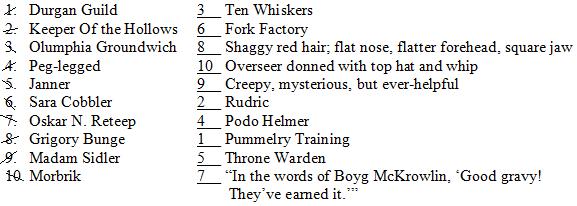
Andrew Peterson must have had similar experiences because they come to us crisp and clear through the pages of his book. The most memorable for me is found in the chapter titled, The Ten Whiskers of Olumphia Groundwich. Allow me to quote at length and see for yourself if my point is not well-taken. The scene is the first day of school, and Nia with her children have just arrived in a carriage at The Guilding Hall and Institute for Hollish Learning. They’ve come to a stop before the stone buildings of the school.

  “Where is everybody?” Leeli asked.
  “In class. Down you go,” Nia said. “We need to speak to the head guildmaster.”
  Janner wanted to ask what a head guildmaster was, but he figured he would know soon enough.
  The three children were as skittish as thwaps in Podo’s garden as Nia marched up the steps and knocked three times on the main door. It swung open immediately, and before them stood a tall, hideous woman in boots and a blue dress. The sleeves were too short, so her knobby wrists and half her forearms stuck out past the frills. Her hair was pulled back in a bun, which made her heavy brow and jaw seem even bigger. She frowned at them with a face that boasted exactly ten curly whiskers: two sprouting from her chin, six on her upper lip, one jutting out from the center of her nose, and one on her left cheek. Janner felt bad for counting them.
  “Oy! Nia Igiby Wingfeather!” the woman barked. Her voice was somehow shrill and husky at the same time. “I was expecting you. Follow.” She spun around and clomped away.
  Nia gave the children a surprised look and led them into the school….
 The ten-whiskered woman stopped and held open a door labeled “Head Guildmadam.” Nia thanked her with a nod and herded the children through. The room was furnished with a small desk and several chairs. A big brown dog snored on a blanket in the corner. Nia gestured for the children to sit and waited until the whiskery dame closed the door and sat at the desk.
  “I figure you don’t remember me,” the woman said with a scowl. “I figure you’re Nia Igiby who up and married a king and left the Hollows. I figure you’re bringing your three pups here for a proper Hollish education. I figure you think you’re somebody now, don’t you?”
  “I do, as a matter of fact,” said Nia. “And I think you’re somebody too.”
  “Oy? Then who, Your Highness? Who is the woman who sits before you?” The woman leaned back in her chair and folded her arms. She stared at Nia and frowned with great effort, which caused the six whiskers on her upper lip and the two on her chin to flick about like the antennae of a bug.
  “Children,” Nia said, still looking the woman in the eye, “I’d like you to meet the guildmadam. Guildmadam Groundwich. I knew her many years ago as Olumphia Groundwich, the Terror of Swainsby Road.”
….
  “Oy!” said Olumphia Groundwich, and she narrowed one eye. “Your mother knows me well. So well, in fact, that she had another name for me. Didn’t you, Nia Igiby? You called me something that no one else dared to call me.”
  “I did,” Nia said after a pause.
  “Tell them.” Mistress Groundwich scratched at a whisker and waved her hand. “Tell them now so we can be done with it.”
  Janner prayed that whatever name Nia called her wouldn’t lead to a fight right there in the guildmadam’s office. He desperately wanted to be on this woman’s good side, though he doubted she had a good side.
  “I called you friend,” Nia said with a smile. “My best friend.”
  “Oy!” Mistress Groundwich said. She leapt to her feet and towered over them. “Oy!” she said again. It startled all three Wingfeather children, who nearly jumped out of their seats.
  Nia embraced Olumphia, who lifted Nia off her feet and made a noise like a growl, at which point the big dog in the corner woke and thumped its tail. Nia looked like one of the children being swung around in one of Podo’s hugs.
  “Nia, my heart is full of joy at seeing you again. I just knew you’d been killed or imprisoned—or—Fanged.” She shot a glance at Kalmar and continued. “But you didn’t! You came back! And with children!”
  “It’s good to see you Olumphia,” Nia laughed. “And head guildmadam! By the hills and the hollows, I’m impressed! You hated school.”
  “I’m as surprised as you are. Never thought anyone would call me Guildmadam. I’m even more surprised that I love it. I always wondered why the Maker made me so tall and lanky, and why he gave me these rogue whiskers. Used to pluck them out every other day, but I found the students more terrified of me with them than without. I don’t have a husband—yet—so what do I care?”
  “Finding a man might be trickier with whiskers,” Nia said.
  “Oy! Hadn’t thought of that.” Olumphia plucked out one of the whiskers. Janner cringed. Olumphia blinked away the water that sprang to her eyes and chuckled. “There! I’ll find me a Hollish prince in no time. The blasted thing will be back by tomorrow evening, though.” Olumphia held up the whisker and inspected it with a frown.

Now, if that doesn’t make you want to get a book from the Wingfeather Saga, in the words of Sapphire Surefoot, “You ain’t in your right mind!”


Get The Monster in the Hollows on amazon.
Series Web Site


Thanks to Rabbit Room Press who kindly provided a copy of the book for review on the CSFF blog tour. The Monster in the Hollows is book three of the Wingfeather Saga.

Sunday, September 18, 2011

CSFF Blog Tour - September, 2011, Day One


Christian Science Fiction and Fantasy Blog Tour (September 2011) - Day One.

The Monster in the Hollows, by Andrew Peterson.


After a long trip across the Dark Sea of Darkness, and the harrowing experiences with the Fangs of Dang, forest-roaming toothy cows, a sea serpent, child slavery in the Fork Factory, and the battle of Kimera, the Igiby family arrives off the shores of Anneira, Nia Igiby’s homeland and its queen. Janner and Kalmer (her sons), Leeli (her daughter), and Podo Helmer (her father and former pirate) arrive with her. Janner had dreamed of living again in Castle Rysen where he was born. But his dreams turn to foolishness. Gnag the Nameless set it afire nine years prior, and it is still burning. 
     Janner was tired of running. He wanted a place to call his own, a place where Fangs didn’t roam, where Stranders didn’t want to cut his throat, and where he and his family could finally be at peace. (p. 9)

The children ask how it is possible that the land was still burning. Nia's answer somberly reveals the gravity of the threat that is pursuing them.
     Nia wiped her eyes. When she spoke, Janner heard the tremble of anger in her voice. “Gnag has hate enough in his heart to melt the very foundations of the castle, down to the bones of the isles itself. He won’t rest until Anniera sinks into the sea.”
    “But why?” Janner asked. “Why does he hate it so much? Who is he, even?”
    “Who knows? When it rages long enough, hate doesn’t need a reason. It burns for the sake of its own heat and devours whatever, or whomever, is set before it. Before the war, rumor came to us about an evil in the mountains—but Throg is a long way from Anniera. We never imagined it would come to us.” Nia closed her eyes. “By the time we realized the Fangs were after Anniera, it was too late. Your father believed the Symian Strait would protect us—or at least give us time to mount a defense.” She shook her head and looked at the children. “The point is, Gnag seemed to come from nowhere, like a crash of lightning. He wanted Anniera. He wanted us dead.” (p. 9,10)

And so, the book begins against the backdrop of an evil entity seeking out their destruction from whom they hope to find haven soon in the Green Hollows, just beyond the burning Anniera. Gnag dwells to the south of the Hollows in the Castle Throg where he “broods on the world’s destruction.” But the Hollows are presumably a sanctuary for several reasons. The folk there are a strong, determined people who have never liked outsiders and have been diligent to keep the Hollows isolated. The land is also protected by a massive, treacherous mountain range that separates it from Gnog's dwelling place; and the deep, twisted forest of Blackwood (whom no one has ever survived) surrounds the Hollows on the east and north. The west is open to the sea. Beside all that, Gnag would not expect to find them in his own back yard—who would be foolish enough to seek refuge there?


Nia is not absolutely certain, but she thinks Gnag made his army of fangs from people. It is probably so. Somewhere in all of the dangers and battles they have been through, Kalmar has fallen victim to this. He was transformed into a Grey Fang, a wolf whose vicious animal appetites overwhelm him at times, though he has learned to control much of it. His eyes are blue, as they were before, but his whole appearance is brutish having a snout, wolfish teeth, and dog-like ears that lay back on his head when he’s sorrowful or embarrassed.

The Green Hollows promises peace and safety, but there is trouble. The Hollow folk hate fangs. Kalmar would have been lynched and murdered if not for Nia’s call for turalay, in which she vouches for Kalmar’s behavior upon pain of the same punishment Kalmar would suffer should he violate his probation.

The family settles in the home of their father’s friend (their father has been lost) and they begin life in the Hollows. It is hard as the children face the brutal tauntings and threats of their schoolmates day in and day out. This becomes quite intense during PT (pummelry training), a class in which Janner and Kalmar are up against those who are at least a year or two older.

There is a monster in the Hollows who is killing livestock, and the citizens are determined to hunt it down and kill it. Who is the monster? Where did he come from, and what is he doing there? What will become of him? The answers to these questions bring the story to an awesome conclusion and set the stage for the final book.

The story and the writing is not like the Chronicles of Narnia, so to compare it to Lewis's classic tales would be absurd. Yet I think it could stand side by side with it. That is, I think the book has the stuff which makes a classic, a classic. Its characters are wonderful and the intertwining of subplots within the main is delightful. The conflict between the Igiby’s and the citizens of the Hollows, especially for the children, brings tension and suspense that keep the story moving, compelling the reader to press on. Humor, villainy, treachery, loyalty, humility, sacrifice and more evoke a wide range of emotion.

I think it is mildly Christian, but I don't think that is a detriment. It does portray the evilness of evil and it reveals to some degree the inner conflicts of conscience that rise in the human heart. It is not a study of these, but it does bring them before the reader. That is all the more a wonder because the young reader's interest is most likely entertainment, and as the story fulfills that element, it does so with a seriousness that is befitting a quality children's story; the kind that a serious Christian writer will strive for.

God is known in the story by the name of Maker, and there is nothing unbiblical that I can detect about the Maker of this fantasy world. The tale does not present a clear message of the Gospel either through pointed declaration or fantastical imagery, so for Christian parents who are looking for such a fantasy, this is not the one. But it is quality literature: wholesome, imaginative, entertaining, and a fine example of the Christian writer who strives, as the image-bearer of God, to reflect the creative attributes of God through his story telling.

Though it is advertised as young adult fantasy (technically age 14 – 21), it is really for middle school readers, roughly age 9 – 12. It is superbly written for that group, and because of that, I think its appeal reaches beyond pre-teens to include young adult and adult.


The Wingfeather saga began in the first volume, On the Edge of the Dark Sea of Darkness (March 18, 2008)


 This was followed by North! Or Be Eaten (August 18, 2009) 


The saga will conclude in the forthcoming novel, The Warden and the Wolf King.

For a drawing of a Grey Fang by Mr. Peterson’s twelve year old son, Aeden, visit his blog, The Crimson Phoenix. You can see another drawing by Justin Gerard at A Fang Of Dang.

Get The Monster in the Hollows on amazon.
Series Web Site


Thanks to Rabbit Room Press who kindly provided a copy of the book for review on the CSFF blog tour. The Monster in the Hollows, by Andrew Peterson, is book three of the Wingfeather Saga.

Wednesday, June 22, 2011

Day Three - June, 2011 CSFF Blog Tour, Darkness Follows

Darkness Follows by Mike Dellosso
Published by Realms, Lake Mary, FL

In this final post, I would like to touch on two things, Dellosso’s writing and the question of what makes Christian fiction, Christian.

The writing is average. Character development is key for any novel to be good. For me, none of the characters drew much empathy. Evoking empathy always goes back to how life-like the characters become in the imagination of the reader. If the reader lives out the character in his mind, the author has done his job well. Certainly, the success of that has a lot to do with the reader, but I think it has more to do with the writer. Granted, creating good characters is not easy and most of us have to work hard at it. I don’t think the characters in Darkness Follows rise much above those that are commonly found in Christian fiction today. My favorite example of good characterization is George Polivka’s Blaggard’s Moon. His is a high standard, and we would all do well to try and meet it. That doesn’t mean we emulate Polivka. But we should study him (and others who equally qualify) to see what factors and techniques he uses that make his characters so good, and strive to use them within the complex of our own personality, vocabulary, temperament, and style.

Having said that the characters drew little empathy from me, I confess that I liked Dellosso’s characters of Symon and his victims, the latter of whom (excluding the state trooper, Ned Coleman) were cameo appearances. Short-lived (no pun intended) but memorable. The fact that they were murdered didn’t elicit empathy because they weren’t around long enough. Even so, they were vivid and interesting.

One of the things all writers commonly make use of is simile. I find simile to be a good litmus of an author’s writing ability. Good writers use simile that fits the situation or mood without excessive verbiage. Bad writers don’t. Using appropriate simile is difficult. When done well, it is like the brushstroke that finishes the masterpiece. When not done well, it is like spinach topping on your least favorite ice cream. Darkness Follows has too much of the latter.

...his words trailed off like a column of smoke into a starless sky. (p 37)
...tickling Molly’s skin like insect legs. (p 50)
Questions, like day-old bug bites, nagged him. (p 57)
Those words rushed back from the past like a winter wind... (p 130)
His hands quivered like the last leaves of autumn buffeted by a stiff November wind. (p 166)
The bullet pierced Symon’s palm like an awl through leather... (p 260)

It’s not that these don’t give us a vivid picture, I think they do. But they just don’t fit and some are overstated. Words trailing off like a column of smoke is good, but the starless sky adds nothing and hampers the effect. Insect legs on Molly’s skin probably wouldn’t tickle, but they sure would draw a reaction. Day-old bug bites presumably itch, but how does itching carry the imagery of nagging. What is the connection between the sudden recollection of a conversation (real or imagined) and a winter wind? Leaves buffeted by a stiff November wind don’t quiver; they thrash about. A speeding bullet through a palm is nothing like the slow-pressured force that pushes an awl through leather.

To be fair, there were some fine examples of simile; here are two:

The line began to move like a segmented worm... (p 83)
A memory, like a gunshot, exploded in Symon’s mind... (p 83)

The question, What makes ‘Christian fiction,’ Christian? is a crucial one. As writers of Christian fiction, we want to get this right. For me, Christian fiction is not truly Christian unless it pointedly and clearly brings in the salient truths of the gospel. One may argue that such a definition is too narrow. Some would say that it should include any fiction written by Christians, predominately for Christians, and does not require a heavy emphasis on the gospel itself. Wholesome themes - love, faithfulness, kindness, graciousness, humility, forgiveness - essentially the fruits of the Spirit delineated by Paul in Galatians 5:22 are sufficient to mark the literary work as Christian. These themes are good, and they are Christian, but they are genuinely so only when they are understood in the light of the Gospel. Christ came to save sinners, not from hell primarily, but from their sins, which has implications not only for one’s eternal destiny, but also for this life. Christ saves his people from their sins, transforming them into a people who grieve over their sin, repent continuously, recognize the deceitfulness of their own sinful hearts, and in an ongoing manner, humbly seek the mercy and grace of the One who saves them that they may overcome worldliness and carnality. As overcomers, they manifest the fruit of the Spirit. Bringing these truths out is what qualifies a novel to be worthy of Christian classification.

This does not mean a Christian can’t write purely for entertainment. Nor does it mean that all the elements of the Christian faith must be treated with equal emphasis. As an image-bearer of God, writing good fiction, creating a world of fiction (reflecting God’s creativeness), even if there is no effort to include Gospel truths, is a worthy vocation, and one that honors God. But if it does not pointedly bring out the truths of the Gospel, let’s not call it Christian.

Darkness Follows is anemically Christian. It mentions the love of Jesus, but doesn’t tell the reader what that means. It provides a contrast between good and evil, but the most pagan of literary works does that because it is impossible to avoid. The Christian novel should show why it is unavoidable through a strong Gospel oriented story.

Dellosso’s novel is dark, and alarmingly so in several places. That in itself doesn’t disqualify it as Christian. What severely damages its qualification as Christian is that the Gospel is absent. Merely including Eva’s need to tell her daddy that Jesus loves him fails to qualify the novel as Christian. Stephen King could write a novel like that, but no one would think of it as Christian.

Many in the world and the professing Church have been told that Jesus loves them yet have none of the grace of God that transforms them from sinner to saint because they misunderstand what that love is. These do not see God’s love side by side with God’s holy hatred of them as sinners (Psalm 5:5) who are under divine condemnation and are powerless to do anything about it because they are dead in their sins (Ephesians 2:1). They don’t understand that their hope is not in any inherent goodness they think they have, nor in any value they think God sees in them. They don’t see that their only hope is in the atonement of Christ through which they may be saved from their sin and sinfulness. Without the clear, pointed presence of the Gospel in a novel, the novel is not Christian.


Participant Links
Mike Dellosso Website
Darkness Follows on Amazon


Thanks to Realms Publishing for kindly providing a copy of Darkness Follows for review on the Christian Science Fiction and Fantasy Blog Tour.

Tuesday, June 21, 2011

Day Two - June, 2011 CSFF Blog Tour, Darkness Follows

Darkness Follows by Mike Dellosso
Published by Realms, Lake Mary, FL

WARNING: THIS ARTICLE IS A SPOILER.

Some may regard the issues I bring out in this article to be much ado about nothing, but I think they are important and have a direct bearing on the quality of the story.

The psychopathic mystery character I mentioned in the Day One post is known as Symon (that was what the voice on the phone called him) but his real name comes to him in a rush after he has gone down from a rifle shot that ‘pierced his palm like an awl through leather.’ Curled in pain on the ground, Symon has another flashback, of having been shot once before, and of a woman kneeling over him mouthing his name, Albert.

His full name is Albert Drake, and the denouement chapter seventy-three contains a transcript of a talk show, Mitch Lewis Live, whose guest is Lucretia Billows, presumably the woman Symon recalls mouthing his name. Based on the transcript the two characters, Albert Drake and Sam Travis were both brainwashed by a Marxist group (the Marxist Brotherhood), and we are to infer from this, I believe, the brainwashing is responsible for the strange behavior of both.

This fits appropriately with Drake who can remember nothing earlier than two months prior although, over the brief time-span of the novel, recollections of his childhood, involvement with the Marxist group, and of his own daughter come back in bits and pieces. His instructions (to kidnap Sam Travis’s daughter, Eva, as a hostage to ensure Sam’s complicity with the assassination attempt) are from a voice over the phone most likely a member of the Marxist group. In the pursuit of the kidnapping, Drake, without feeling (which he finds troublesome), murders six people who live in the Gettysburg area.

Looking back over the book, Sam Travis’s brainwashing can be taken as a factor in his behavior and strange experiences, but some of those experiences have an other-worldly feel, and intentionally so, I think, by the author. They are meant to be taken at face value as truly other-worldly. As such, these particular experiences are not attributable to brainwashing. Rather than finding a lucid explanation for them, their presence is puzzling.

To see this, we have to step back a little and try to see the brainwashing of Sam Travis in the context of the big picture, beginning with the prologue.

Samuel Whiting, the inaugural figure of the prologue, is a historic personality, a Captain of the Union Army at Gettysburg. He is writing in his journal, and the content of his writing is given only in general terms. However, I believe we are to infer from the modern day entries Sam Travis makes in his daughter’s notebook (journal entries as though authored by Captain Whiting, but actually written in Sam Travis’s hand) that the Captain wrote of his despair over the needless death and suffering of the battle for which he blames President Lincoln. While writing, a mysterious darkness engulfs the Captain. The reader has the sense that that darkness plays a significant role in his decision to assassinate President Lincoln, an intuition that is more and more confirmed as the novel unfolds. The point here - there is an other-worldly presence at the outset, the darkness, that enshrouds the Union Captain.

In the present day, Sam Travis, as noted, composes journal entries as if written by Captain Whiting, but does so unconsciously. I wonder, is this meant to be the result of his brainwashing, or something else? That explanation might be discounted if we consider the final chapters where it becomes known that the real Captain Whiting is a relative of Sam’s (a great, great, great uncle) and that he is not the only one in the family to have been insane (‘gone off the deep end’, p 274) There is a darkness that has been in the family which affected not only Whiting, but also Sam’s brother, Tommy (a chilling psycho), and Sam himself. If the darkness that followed his family into the present day is the cause of Sam’s ‘trance writing’ in his daughter’s notebook, then Sam is a golden find for the Marxists, and their brainwashing techniques would have had to be, I think, quite sophisticated to make use of it.

But the reason given for Sam’s enlistment as related by Lucretia Billows is that Albert (Symon, the psycho murderer) didn’t have the skills the Marxists needed, and Sam Travis did. Those skills presumably are his expertise with the rifle. Lucretia also notes that the Marxists became involved with the occult and that it was at their deepest involvement when they began to work on Sam. Was it through the occult they were able to discern Sam’s dark side and manipulate it? If so, that would that have been a useful point, which could have been more obviously developed in the story. But we don’t know for sure and are left guessing, which for some may be acceptable, but it leaves me unsatisfied.

It may be that the author deliberately, without spelling it out, intends for the trance writing to be an aspect of the insanity complex that follows Sam’s family, because the symptoms of it appear back in the original scene with Captain Whiting:

After dipping the tip of his quill into an inkwell, he put the tip to the paper and began to write. The words flowed from his hand, though they were not born of him... His quill moved across the paper more rapidly now, the point carving words--vitriol--at an alarming pace. p. 1, 2

If Dellosso intentionally depicts Captain Whiting to be induced with trance writing and purposely meant it to be one of the insanity elements that are passed down through the family and to have it reappear in Sam Travis’s case, I must say that is ingenious.

But here’s what I find confusing. The Marxist group presumably brainwashed Sam Travis, just as they did Albert Drake. When, where, and how is absent and unexplained and would not only have made the story cohere better, but also provided ample opportunity to develop Sam Travis’s character and psyche more thoroughly, a problem I find with most of the characters in the book (Symon excepted to some degree).

If perchance we are reading too much into Lucretia Billows talk show account, and Sam Travis was not brainwashed, it is not clear at all what the Marxists did do in an effort to use his expertise as a shooter in their plan to assassinate the presidential hopeful, Stephen Lincoln. So I wonder how Sam came to the decision to assassinate the target. Was it because of brainwashing or because of the darkness (expressed through the trance writing and, near the end, through a psychological manifestation of his dead brother, Tommy)? Or was it both? Did the Marxist group become aware of Sam’s bent toward a dark side, connect it to Samuel Whiting and the inherent proclivity to trance writing, and so brainwash him in such a way as to use that? It was essentially Sam Travis’s unconscious journal entries that brought him to the conclusion that he should assassinate Senator Lincoln. Was that a result of brainwashing with the unintentional but fortunate (for the Marxist group) side effect of the trance writing, or was the Marxist group aware of the trance writing trait and intended all along to use the brainwashing toward that end. Who knows, it’s not unequivocally connected if that is so. And again, if it were intentional, it would have been a fantastic opportunity to bring the story to a deeper and more mature development.

Here is another matter which is a loose end that I think should have been resolved. In the first chapter, Sam hallucinates (maybe) and hears the Gettysburg battle going on around his home. This might be the result of brainwashing, but the surreal bullet that shattered the window loudly enough to awaken his daughter and wife who are sound asleep upstairs is never found by Sam’s wife or the state trooper, Ned Coleman. What actually shattered the window is never explained (as far as I remember) and though at first it seemed to be significant, it never comes to mean anything. It also lends support to the possibility that the sounds of the Gettysburg battle were not purely mental but also involved external, other-worldly forces as well, which if so, was likewise ignored in the rest of the book.

The appearances of Tommy, Sam Travis’s dead brother, might be attributable to brainwashing, especially given the traumatic experience of having to kill his own brother to save his mother and father from a grisly murder at Tommy’s hands. So Sam’s hallucinatory experiences of Tommy’s manifestations are understandable from that point. But Sam also sees Jacob, albeit not until the climax is about to unfold. Jacob is not a by-product of the brainwashing and not intended to be a hallucinatory figment. Jacob is truly other-worldly, though a benign figure.

Jacob, until the final chapters, is an invisible friend of Eva, taken to be a make-believe playmate by her parents, but the reader is left with the strong impression that he is real. Jacob continually encourages Eva to tell her daddy that she loves him. He even reveals that her dad is going to do something very bad, and that she needs to pray for him.

The reality of Jacob is confirmed when he appears to Sam and assists him in finding his way to his daughter and her abductor, Symon. The confusion for me is that if Jacob, in the end, is not restricted to intervene through Eva only, why did he not do so directly with Sam from the start?

All of these may be making a mountain out of a molehill but the author who thinks through his story thoroughly, works such issues out. Granted, one can probably find inconsistencies and dangling themes in the best works, but I think these in Darkness Follows could have been handled better.

Participant Links
Mike Dellosso Website
Darkness Follows on Amazon


Thanks to Realms Publishing for kindly providing a copy of Darkness Follows for review on the Christian Science Fiction and Fantasy Blog Tour.

Sunday, June 19, 2011

Darkness Follows by Mike Dellosso, Day One - June, 2011 CSFF Blog Tour

Darkness Follows by Mike Dellosso
Published by Realms, Lake Mary, FL

Darkness Follows by Mike Dellosso is a novel that incorporates elements amenable to suspense: mystery, intrigue, and dark psychological intensity.

The setting is Gettysburg, Pennsylvania, the battle site of the bloodiest conflict of the American Civil War and the greatest artillery barrage on the North American continent. The prologue introduces Samuel Whiting, a captain of the Union Army in his tent at the end of a bloody day of fighting. He is disillusioned about the cause of the war and the way in which it is being fought. He takes up his pen and writes in his journal. As he writes, the words come quickly and with ease though they are not ‘born of him, but of something else, something dark and sinister, something to which he had finally given himself.” (p 2) Captain Whiting detects a dark, shadowy presence in the tent with him, accompanied by a low moaning wind that snuffs out the light of his writing candle and leaves him in darkness. This establishes intrigue at the outset and contains the kernel that ultimately binds various threads together, although there are some threads left dangling.

In the first chapter, the scene shifts to modern day Gettysburg, and the night scene of Sam Travis who awakens from a bad dream that has terrified him. The only hint of what the dream was about is the mention of his brother and a shot, and Sam Travis’s post-dream recollection of a voice in the past, ‘You did what you had to do, son.’

Sam rises for a drink of water assuring his wife Molly that he’s all right. He checks on their seven-year-old daughter Eva, who is soundly sleeping in her room. Sam moves on to the bathroom were he splashes down his face with water and studies the scar on his face in the mirror. The scar signifies something happened, which has made the last six months very trying for the Travis family.

Then Sam Travis hears a voice from downstairs calling his name. He recognizes it as the voice of his dead brother, Tommy. Sam has been hearing Tommy’s voice quite a bit lately, “a hundred ghostly times since the accident that had turned his own brain to mush. The doctor called them auditory hallucinations.”

Later, a mystery figure comes into the book, who doesn’t know who he is and is a psychopath who finds it troubling that he feels no remorse or guilt for the murders he commits. He asks all his victims if they have ever seen him, or know who he is - there is none who does. He recollects on a variety of occasions a voice on the telephone giving him instructions as to what he is to do, but he doesn’t know whose voice it is though he is compelled to follow it. These instructions include something he is to do to Sam and Molly’s daughter, Eva.

There is a Senator who recently has had a conversion from the liberal principles of the Democratic Party and become a Republican making him the leading Republican presidential hopeful.

The Senator (whose name I withhold lest it catalytically gives away too much), Sam Travis, the mystery psycho, and Eva all come together in a climactic ending that leaves one scratching his head, until he continues on and reads the post-climactic chapters, which, for the most part brings satisfying resolution to the puzzlements.

One more figure, a character that Eva sees, but no one else, whose name is Jacob and informs Eva that her Dad is afraid and needs her prayers. After a time, Sam and Molly become more and more concerned about Eva’s conversations with Jacob (Molly overhears one) and Eva’s insistence that Jacob, who is ‘all shiny like someone dipped him in glue and rolled him in sparkles,’ (p 50) is real.

The intrigue builds on a variety of fronts, and centers around the dark and morose.

Molly’s childhood was marred by a verbally abusive father.

The mystery figure, stymied about who he is, dredges up images and conversations that help bring his past back, though it is all quite disconnected. His father beat his mother and raped his sister. A woman laughs at him, another shoots him. Eventually he realizes he was married and has a daughter. The knowledge of a daughter has the tendency to bring mild restraint to his otherwise unbridled, murderous rage.

Sam Travis recalls his childhood in bits and pieces throughout the story, revealing his horribly disturbed brother, Tommy, and a frightening secret. He finds mysterious entries in his own hand in his daughter’s composition book which appear to be the entries of Samuel Whiting, dated during the Battle of Gettysburg, expressing a continuing mental descent into a despondent and darkened abyss, and eventually, to a resolution to kill the President.

The story qualifies as suspense, but it has the feel of being rushed. There are many places where a slower development of a situation or character would have been an enhancement. As an example, much of what takes place in the first chapter comes too fast. A case in point is what comes on the second page of the first chapter where already, without preparation for the reader or transition, Sam hears the voice of his dead brother, Tommy. To me, it feels out of joint and awkward.

In only a few places did I like the writing. On the whole, I found it average. If I can follow through and post each day of the Tour, my aim on the second day is to discuss Dellosso’s writing in a little more detail, both the good and the bad, and identify things that I think were puzzling. On the third, I want to say something briefly about the ‘Christian’ nature of the book.


Participant Links
Mike Dellosso Website
Darkness Follows on Amazon


Thanks to Realms Publishing for kindly providing a copy of Darkness Follows for review on the Christian Science Fiction and Fantasy Blog Tour.

Sunday, April 10, 2011

Love Wins: A Critical Review – Part 1

God’s Love and The Cross


Given the title, Love Wins: A Book About Heaven, Hell, and the Fate of Every Person Who Ever Lived, and the content of the book, I am confident that Rob Bell’s foundational thesis is buried in a statement he makes regarding hell:

We do ourselves great harm when we confuse the very essence of God, which is love, with the very real consequences of rejecting and resisting that love, which creates what we call hell. (p 177)
Rob Bell’s thesis is that the very essence of God is love. The word 'very' has several meanings, but the way in which he uses it here is a common use, and it means ‘complete and absolute.’ He is using this to describe the essence of God, that is, what God is in his being. To say that the very essence of God is love is to say everything that God is in and of himself is nothing else than love. Love controls God; nothing He does, thinks, says is contrary to love because it is impossible to be otherwise without contradicting Himself.

This verges on saying that Love is God, but I doubt that Bell would go that far. God is a Trinitarian being, one essence that exists in three persons, Father, Son, and Spirit. I can agree from a Trinitarian perspective that the very essence of God is love because each person of that one essence loves the other supremely. But that is not what Bell is talking about. He is talking about God’s love toward objects outside the inter-Trinitarian fellowship. He is talking about God’s love for his creation and in particular for that creature made in his image, man and woman.

To say simply that very essence of God is love is to make a statement that is not very clear and raises a serious question, If God is completely and absolutely love, does that mean He has no other attributes?

I readily admit that is an absurd question, but the asking of it points to the absurdity of the idea that God in his essence is completely and absolutely love in relation to his creation. The very fact that by divine fiat (God said, ‘Let there be light.’) God brought the creation into being out of nothing clearly reveals his omnipotence and omniscience not to mention his sovereignty (Romans 1:20; Psalm 19:1-4a).

I think Bell would affirm these attributes to one degree or another. But in doing so, he faces some serious challenges, which he either glosses over or ignores outright.

If God does have these other attributes then how can Bell be so dogmatic that love is the essential attribute of God? If the attributes of omnipotence and omniscience are granted, then we must also consider other attributes such as God’s holiness and justice (seeing that the Bible does so, Psalm 99:3, 5, 9; Isaiah 6:3; Habakkuk 1:13; 2 Timothy 4:8; Revelation 4:8; 6:10; 16:7; 19:2).

I mention holiness and justice in particular because I think Bell does not understand them aright and therefore does not appreciate their impact on the very things he talks about in his book: heaven, hell, and the fate of every person who ever lived. Bell’s flawed conception of these unfavorably affects his view on the love of God and divine punishment.

Bell’s position is one-sided. It is not the love of God alone that has direct implications for punishment, but the holiness and justice of God do as well. If God is utterly holy and absolutely just how can He not hold men accountable for their sins and inflict everlasting pain and suffering for their heinous offenses against Himself?

Bell’s answer on the one hand is that God simply cannot do that, for that kind of God, who would consign a man to unending torment for sins committed during a mere life-time, is unloving and cruel.

Of all the billions of people who have ever lived, will only a select number “make it to a better place” and every single other person suffer in torment and punishment forever? Is this acceptable to God? Has God created millions of people over tens of thousands of years who are going to spend eternity in anguish? Can God do this or even allow this, and still claim to be a loving God? (p 2)

The biblical answer to each of these questions is a resounding Yes! and I plan to show how so in a later article.

On the other hand, Bell’s answer that prohibits everlasting punishment is the cross of Christ, but his assessment of the cross is superficial. He spends no time exegeting the passages that he cites, he simply states the text without any explanation of its meaning in terms of its context or corpus of belief held by the writer. Regarding the cross he tallies so-called metaphors that the New Testament writers use to explain the cross. It is a sacrifice that does away with all other sacrifices (pp 123-126), reconciles all things to God (p 125), pays the price to free guilty sinners (p 126), destroys death and overcomes the world, (p 126), and buys back (redeems) something that was lost (p 127). Bell is very earnest to convey the idea that these metaphors were adequate for their time and place in history and culture, but we should not be limited to them:

The point, then, isn’t to narrow it [the meaning of the cross] to one particular metaphor, image, explanation, or mechanism. To elevate one over the others, to insist that there’s a “correct” or “right” one, is to miss the brilliant, creative work these first Christians were doing when they used these images and metaphors. They were reading their world, looking for ways to communicate this epic event in ways their listeners could grasp.

The point then, as it is now, is Jesus. The divine in flesh and blood. He’s where the life is. (p 129)
If I understand Bell’s message here, the so-called use of metaphor makes all the New Testament renderings of the meaning of the cross dated. Important as they were in their time, they are not so useful for us now. Their real usefulness in the New Testament world, as it should be now, is to make a point about something deeper, and that point is “...Jesus...where the life is.” An arcane pronouncement, which Bell makes no diligent effort to elucidate.

To place the various perspectives of the New Testament writers of the cross on the ash heap of outworn metaphors and images is telling of Bell’s superficiality when it comes to hermeneutics (the interpretation of scripture). It is particularly exposed with the metaphor of sacrifice. Bell cites Hebrews 9:26 as an example:

We read in Hebrews 9 that Jesus “has appeared once for all at the culmination of the ages to do away with sin by the sacrifice of himself.” (p 123)

Bell explains this as a metaphor to counter the centuries old practice of pagan ritual sacrifice whereby a peaceful relationship between us and the gods was hopefully attained:

That’s how it worked. Offer something, show that you’re serious, make amends, find favor, and then hope that was enough to get what you needed.

So when the writer of Hebrews insisted that Jesus was the last sacrifice ever needed, that was a revolutionary idea. To make that claim in those days? Stunning. Unprecedented.

Whole cultures centered around keeping the gods pleased. This was obviously a very costly, time-consuming ordeal, not to mention an anxiety-producing one. You never knew if you’d fully pleased the gods and paid the debt properly. And now the writer is announcing that those days are over because of Jesus dying on the cross. Done away with. Gone. Irrelevant.

The psychological impact alone would have been extraordinary - no more anxiety, no more worry, no more stress, no more wondering if the gods were pleased with you or ready to strike you down. There was no more need for any of that sacrifice, because Jesus was the ultimate sacrifice that thoroughly pleased the only God who ever mattered. (pp 124, 125)

For the New Testament writers, sacrifice was not a figure of speech by which the pagan might come to understand the folly of his ritual and abate his fear of never appeasing the gods. Nor was the imagery of sacrifice a random notion that seemed a likely choice to make Jesus intellectually or culturally palatable to his hearers.

Sacrifice was not a metaphor. Sacrifice rose out of the history of redemption, namely, the sacrificial system of the Old Testament. For the writer to the Hebrews, the cross is without meaning if it is not understood in the light of Old Testament sacrifice, and if Bell had been honest to include the context of the verse he cites, he would have had to bring the meaning of Old Testament sacrifice into the sacrifice of Christ:

Of this, John Murray writes:

It lies on the face of the New Testament that Christ’s work is construed as sacrifice. And the only question is: what notion of sacrifice governs the pervasive use of the term sacrifice as it is applied to the work of Christ? This question can be answered only by determining what was the notion of sacrifice entertained by the New Testament speakers and writers. Steeped as these were in the language and ideas of the Old Testament, there is but one direction in which to seek their interpretation of the meaning and effect of sacrifice. (Redemption Accomplished And Applied, p 24).

Murray then expounds the meaning of sacrifice on the basis of the Old Testament ritual, in particular, the Day of Atonement.

I am making a special point regarding Bell’s hermeneutic because it should throw up a red flag. If he so blithely misconstrues the purpose of New Testament writers in the explanation of the cross in this one aspect - sacrifice - can he be trusted with his assessment on other aspects. Does he have any real understanding of the nature and scope of Christ’s death as the once-for-all satisfaction for the just punishment of God for the sins of his people? Does he truly understand the meaning of 1 Peter 2:24:

Who his own self bare our sins in his own body on the tree, that we, being dead to sins, should live unto righteousness: by whose stripes you were healed.