Showing posts with label Andrew Peterson. Show all posts

Tuesday, March 18, 2014

Francis Schaeffer Perspective #6 - Art Form's Versatility in Message Types


Perspective #6: Art forms can be used for any type of message from pure fantasy to detailed history.

If we recall the discussion in Perspective #1, Schaeffer ruled out the nature of art as exclusively an embodiment of a message. Rather, he contends, the art communicates the world-view of the artist. In that perspective, a message seems much less important than the aesthetic value or its ‘work-of-artness.’ But now, the usefulness of art as a communicator of a message comes to the fore. I don’t think this is a shift in his thinking, but simply coming around to what he tended to deemphasize (but not dismiss) in the earlier perspective.

Schaeffer recognizes that art does communicate a message. The question that I raise is what is the relation between the art and the message? Does the aesthetic value of art have the priority over the message it communicates? Schaeffer seems to think so (Perspective #1). The answer to that question controls what subject the artist focuses on, and how his artwork portrays that subject. If message has priority, an artist is going to be careful, perhaps in a tedious way, of not only what the subject is, but the way it is dealt with. If the art has the priority, the artist will probably do his work more through whim and fancy and self-gratification.

When we stand in front of any painting, we naturally look for something that is recognizable. When we stand in front of some paintings, we are initially struck by the craftsmanship of the work. The more exquisite the art, the more we are caught up in its beauty. We are initially not looking for a message. In other paintings, the art may be exquisite, but its message so powerfully obvious, that the message takes the prominence. In still other paintings, the art and the message seem to hit the viewer at the same time with equal force.

Consider Emanuel Leutze’s 1851 oil painting, Washington Crossing the Delaware. The artwork is top-notch, and its beauty and magnificence delights the eye. At the same time, one is equally struck by the drama of the moment as he beholds a confident, stoic Washington[1] at the head of the force. It conveys the character and emotion of the General at what was probably the darkest hour of the American Revolution. It undoubtedly depicted Washington as he was perceived by both soldier and citizen. Washington is at least part of the message, and it comes clearly across to the viewer. The technical quality is superb reinforcing the message. The message is there in all of its beauty because of the artwork. Both art and message have an equal impact. If there is a message in art, the profundity, clarity, and coherency of that message is dependent on the profundity, clarity, and coherency of the artwork itself. I think we can say the reverse is true as well.

For writers of Christian fiction and fantasy, the priority between the art and the message, and what mutual affect there is between the message and the art of our writing is not a small matter. It will control what we write about and how we write it. The gospel is a profound message, going deeper than any mystery of science and nature. The gospel is a wondrous message, soaring higher than any marvel the modern academician stands in awe of. If our writing is truly Christian, it should not be based on crass whim and fancy, and certainly not self-gratification (it's a feel-good story). It should plumb the gospel’s depths and reach for its stars. As for the writing itself – the author should strive to write as profoundly and as beautifully as the message. One does not offer a gem of great worth in a shoe box.

In a loose way, whim and fancy cannot help but appear in Christian fantasy if we think of it as pulling things out of the imagination that have no definable existence in reality. But it is not willy-nilly. There is care for what might show up in our writing, and diligent attention to the message behind the 'whim and fancy' of our imagination assures a fitting place for it in our story. Andrew Peterson's toothy cows add a delightful twist to his tale. Taking what is ordinarily an amiable figure in the young child's mind, he turns the friendly into the frightening by simply adding a slight deviation (the toothiness). The presence of the toothy cows adds another element of danger to an increasingly precarious adventure. It does that potently because it connects so well with the young reader. It faces a more stringent test - the adult reader. I think it will pass. I suspect it will evoke long forgotten impressions of his youthful imagination. It did for me.


[1] Undoubtedly, Washington had a stolid temperament that inspired confidence of those under him. Yet early on there were many who quit the war, so to speak, when their enlistments were up. They took their government issued rifles with them. When Washington met with his officers to go over the final details of the crossing on Christmas Eve, 1776, he may have exuded confidence, but in private he was not so. David McCullough writes, “Years later, [physician Benjamin] Rush would recall a private meeting with Washington at Buckingham, during which Washington seemed ‘much depressed.’ In ‘affecting terms,’ he described the state of the army. As they talked, Washington kept writing something with his pen on small pieces of paper. When one of them fell to the floor by Rush’s foot, he saw what was written: ‘Victory or Death.’ It was to be the password for the night.” 1776, Simon and Schuster, 2005.

Friday, March 14, 2014

Francis Schaeffer Perspective #5, Four Basic Standards to Apply to a Work of Art

Perspective #5: There are four basic standards that one must apply to a work of art: (a) technical excellence, (b) validity, (c) intellectual content, the world view which comes through, and (d) the integration of content and vehicle.

Schaeffer contends that a great artist should be recognized for his technical excellence regardless of the content or the world-view which comes through. I agree. Schaeffer uses painting to illustrate his meaning: color, form, balance, texture of the paint, the handling of lines, the unity of the canvas. The painting (or any kind of drawing for that matter) has a great many elements that go into its creation. Earlier in the essay, Schaeffer refers to these as symbolic vocabulary in an attempt to show the parallel with literature. This implies that art, whether graphic or literary, has a common vocabulary (as both say something intelligible) which is governed by ‘linguistic’ rules. Through these rules, the speech of art allows the artist to be creative and mimic (as an image bearer) the creativity of God (who spoke the words, “Light be!” and there was light). When we honor the pagan artist for his excellence, we are utltimately honoring the divine image in him and thereby the One after whom the image is patterned.

The potential for technical excellence resides in the secular[1] writer of speculative fiction because that is the way the Creator made him. If a secular writer has reached realms of excellence of which we stand in awe, he should be recognized. We should read his works not only for entertainment, but also that we may learn how to write better. Additionally, if he has written anything on how to write, it would behoove us to make good use of it.[2]

The second criterion, validity, is whether or not the artist is true to himself and his world-view, or whether he is doing his work for the sake of another.  If an artist paints or writes for the sake of a patron (which can be anybody or anything the artists wants to gain the approval of or have access to) his art has no validity.

I have often thought of how writing in a (pulp) art genre which is hugely popular and sells well (Christian Romance, for example; see C. S. Lakin’s post, Genre Versus Author Platform: Which Matters Most) might be a way to gain recognition for one’s real work, reflecting his real writing interests. To do so, according to this criterion, would discredit that work as a work of art. I agree, and if I am a purist about this business of writing, I won’t attempt to do so. Unless, of course, my interest changes which poses the challenge to actually write in a different genre to see if (a) I can actually do it, and (b) I might actually like it – it rings true to me. With regard to the romance novel, I think I am quite sure that neither (a) nor (b) would hold for me. But it may be worth looking into the market to see what sells and whether I might have an affinity for it.

The third criterion, intellectual content, is to assess the world-view that comes through the art. It must be judged in terms of a biblical world-view. A work of art should never be free from the judgment of the Word of God. The logic behind this is sound: if a work of art reflects the artist’s world-view then just as the thinking of all men, great and small, profound or superficial, is judged by God, and all will one day answer to God for their world-view, the art work itself is, therefore, subject to the same kind of judgment. In practice, I’m not quite sure what this means. What does it mean to pass judgment on a work of art? We have already granted the artist his honor if his work is excellent. Does it mean following the praise we deplore it for its message? I think that is allowable, but we must be careful that it does not open the door to defame the excellency of the work and the artist. How much that is possible, I’m not sure. It is certain that open judgment of the work is necessary because, as Schaeffer contends, the richer and greater the work, the more powerful it is in pressing home its message.

This holds true for speculative fiction. Much non-Christian science fiction and fantasy is rooted in evolutionary theory, and it seems easy for the Christian reader to ignore that. I enjoyed Carl Sagan’s novel Contact which is about man’s first detection of extra-terrestrial intelligence through the means advocated by the National Research Council (an electromagnetic signature). The whole premise of SETI (Search for Extra-Terrestrial Intelligence) is based on the high probability that intelligent life could have risen and developed elsewhere in the universe. The Drake Equation used to come up with the number[3] has evolutionary assumptions built into it. As entertaining as Contact was, and as technically appealing as it was, the caveat must be sounded by the Christian reviewer that the world-view that comes through is anti-biblical.

The fourth criterion is how well the artist has suited the vehicle to the message. “For works which are truly great, there is a correlation between the style and content.” As high fantasy, Lord of the Rings was written in a style that fit the epic character of the story. The imaginary world was best portrayed through a sophisticated and lofty literary style. Tolkien spent great detail in describing landscape and terrain, moving the story at its own pace (not rushed, but unfolding slowly like it does in real life), salt-and-peppered with proportionate amounts of royal and common dialogue, great battles, and personal struggles. Much of this had to do with the readership Tolkien had in mind. It was not a children’s fantasy like the Chronicles of Narnia, and though the Narnia stories have a sophistication of their own and are superbly written, they are still a different style.

Much of today’s young adult speculative fiction is written in a style that suits its audience, but it is not very sophisticated and there is little elegance. Instead, there is corniness, cartoonishness, and melodrama. Perhaps the author thinks that is the only thing that will appeal to the younger ones. I ask, so what? Give them something they can look back on in adulthood and see a beauty and elegance that appeals even then. A children’s story should never be outgrown by its readership. C. S. Lewis put it this way, “I am almost inclined to set it up as a canon that a children’s story which is enjoyed only by children is a bad children’s story. The good ones last. A waltz which you can like only when you are waltzing is a bad waltz.”[4] In my opinion, Andrew Peterson’s Wing-feather Saga is the only modern Christian children’s saga that I have read that measures up to this criterion.


[1] I am using secular in a somewhat liberal way to include all who do not embrace Christ as Lord and Savior. Such ones may be theists of the Judeo-Christian tradition, but there is nothing in their claims or behavior to indicate they are of those whose hearts have been changed and are faithful followers of Christ. The world-view that comes through in their writing speaks volumes in this regard.
[2] I recommend Stephen King’s On Writing. I have read others, but I like his best because of the style, and also because I like his dinosaur analogy on how a story develops. One caveat: his language is coarse at times. If you’re looking for a more technical approach with lots of examples from modern day classics, I recommend Structuring Your Novel: From Basic Idea to Finished Manuscript by John D. Fitzgerald (Great Brain series) and Robert C Meredith. Orson Scott Card (Ender’s Game) has written Character and Viewpoint, How to Write Science Fiction and Fantasy, and is a contributor to Complete Guide to Writing Science Fiction: Volume One, First Contact.
[3]  Estimated by Sagan at 1,000,000 in our galaxy when he wrote Broca’s Brain (1974), ten times that now because of an estimated increase in the number of rotating planets around red dwarfs which are deemed to have a higher probability to support life.
[4] C. S. Lewis, “Three Ways of Writing for Children,” in On Stories and Other Essays on Literature, ed. Walter Hooper (New York, NY: Harcourt Brace Janovich, Publishers, 1982), 33.

Monday, January 13, 2014

Francis Schaeffer’s Perspective #2: The Strength of Art Forms

This is the second article in a series on Francis A. Schaeffer's "Perspectives on Art" in The Christian Imagination, ed. Leland Ryken (Colorado Springs, Colorado: Waterbrook Press, 2002).

Perspective #2. Art forms add strength to the world which shows through, no matter what the world view is or whether the world view is true or false.

Rembrandt’s Carcass of Beef serves to illustrate how the form of art adds strength to the world which it manifests.

“Rembrandt’s art causes us to see the side of beef in a concentrated way, and, speaking for myself, after looking and looking at this picture, I have never been able to look at a side of beef in a butcher shop with the superficiality I did before.” (p 37).

Unfortunately, Schaeffer did not go into a little more detail about the differences in the way he looked at a beef carcass before and after the Rembrandt experience. I think the proverb ‘beauty is in the eye of the beholder’ has some bearing on this. Looking at art is subjective. No two persons will stand in front of the Carcass of Beef and see the same thing. An educated eye will look at art differently from the way it looks at the world which the art reflects. Even the uneducated eye – to see a reproduction of the real world from the hand of the artist alone says something, not only about the artist, but the real world. There is intrigue over why the artist chose the subject and how he transferred what he sees onto the canvas. The final art product carries the full weight of that intrigue.

The art form of fiction shares the nature of the art form of the Rembrandt.  The page is the canvas on which the story is painted and the words are the oils applied with the skillful strokes of grammar and syntax. The writer produces a story that has its ties with the real and ordinary, and places it before the reader ‘in a concentrated way.’  

Schaeffer kept looking and looking at the painting. It had a wondrous appeal. I think, however, the bare fact it was hanging in the Louvre with Rembrandt’s name on it might have raised the appeal several degrees. The works of the masters, or even lesser ones of still lofty reputation, evoke a prejudiced eye. Perhaps the mystique of the artist himself heightens one’s sensitivity to see greatness when it would otherwise be missed. There are artists who are missed even though their works are great because they do not have the celebrity. This holds true for many writers, especially Christian, and to put a finer point on it, Christian speculative fiction writers.[1]

Regardless of the celebrity element, I think we may assume that Rembrandt’s art is capable of having a profound impact in precisely the way Schaeffer hints because it is focused (concentrated). What Schaeffer saw was a result of Rembrandt’s ingenious eye scrutinizing the hanging beef in a way that others do not; perhaps, cannot. Not only his perception, but also his touch makes the difference – a photograph of the same side of beef would not bring out the same subtleties, unless that photo was the art work of a professional photographer whose use of light and dark and angle reveals things that a mere random shot would not.

Schaeffer observes that the side of beef phenomenon holds for literature, that ‘good prose as an art form has something that bad prose does not’ and ‘poetry has something good prose does not.’ The something is the side of beef factor, the thing that grabs one’s attention and increasingly occupies it. I agree in the general direction this line of thought takes. However, I balk at the idea that poetry has something that good prose does not, and I think that much of the reason has to do with me, a left-brained reader. I rarely come away with something moving or epiphanic from poetry. I struggle with Frost and Shakespeare. For me, the poetic form more often than not obscures and confuses. That is my experience and must own up to it. But good prose, ah. Good prose has quite a different effect. It sometimes reaches the intensity of hearing Mozart or Bach or Beethoven – it moves. It opens my imagination to nuances of the truth known and heretofore unknown, and its meaning becomes intellectually and emotionally aesthetic.


Obviously, good prose does far more than bad prose, but it is a point worth making. It is a strong reminder to authors of Christian fiction that their prose needs to be top notch. None of us is a Lewis or a Tolkien when it comes to speculative fiction, regardless of those dastardly over-zealous reviews that compare our work to theirs. I had one refer to The Oerken Leaves (now rewritten as The Oerken Tree) as C. S. Lewis meets Mark Twain. Another compared it to Lewis Carroll’s Alice in Wonderland. Another wrote, ‘If you like Lewis and Tolkien, you’re going to  love this.’ They all make me cringe because it just is not so. Yet, I hope that The Oerken Tree is good prose, and I am not so sure it (or your work) has to be worthy to sit side by side with the Greats in order to be considered top notch. But it surely needs to be several huge steps in that direction. In my opinion, Andrew Peterson’s Wingfeather Saga is there. Polivka’s Blaggard’s Moon should be sitting at least on the same shelf.


There are many Christian young adult fantasy works that have become quite popular in the last decade, and their authors are hailed as great writers. But I think their writings fall in the category of bad prose simply because it is bad art. The good word-artist paints with elegance and beauty. It does not have to be like the masters, but there should be some breath-taking moments in them. Many do not rise much above finger painting and paint by numbers. Few of us bring the reader into a Carcass of Beef experience.


[1] In my opinion, there is not many current day works of this type being produced that is worthy of celebrity fame simply because the writing is only average or slightly better or worse. On the other hand, there are a few who are quite worthy, but the ascription of ‘Christian’ and ‘speculative’ hinder their recognition. It is difficult to gain acknowledgement, as any writer knows, no matter how good the writing. Christian speculative fiction especially. The Christian Science Fiction and Fantasy (CSFF) blog tour has been promoting the genre since 2006. Rebecca Luella Miller administrates the tour. She also administers Speculative Faith, which features articles by authors and agents in the genre. The CSFF blog tour features a novel every month in which the members that participate post a review of the novel or a discussion of something closely related to it. Some provide an interview with the author. Typically, the participating member can receive a courtesy copy of the novel for the review. It is a great way to add to one’s library. The tour lasts three days. The critiques, for the most part, are very insightful and objective. If you think you might want to join the tour, visit here.

Wednesday, September 21, 2011

CSFF Blog Tour - September 2011, Day Three

Christian Science Fiction and Fantasy Blog Tour (September 2011) - Day Three.

The Monster in the Hollows, by Andrew Peterson.
Day One Post
Day Two Post

In my first post I mentioned that because The Monster in the Hollows was well-written for the middle schooler, it would also be enjoyed by those beyond middle school age, i.e., by young adults and adults. Of course, I’m talking about stories written for children roughly between 8 and 12 years of age, and which are quality children’s stories like The Wind in the Willows, The Wizard of Oz, The Chronicles of Narnia, The Wouldbegoods, and The Monster in the Hollows. There were comments to the post that agreed with my observation. But is it a valid point? Is it credible to say that a level of writing that appeals to children would, by virtue of that intrinsic appeal, also be favored by older youth and adults? Because the adult is more mature both intellectually and psychologically, would it ordinarily be an embarrassment for the adult to be caught delighting in a children’s story?


I can only answer that in terms of my own response to such literature. My makeup – mental and psychological – is unique to me, but I don’t think absolutely so. In other words, the reasons for which good children’s literature appeals to me as an adult are the same reasons that other adults enjoy such literature. To be sure, the character of my response has subtle and not-so-subtle differences when compared to the response of others. But I think that when a literary work for children is enjoyed by older youth and adults, it is fundamentally for the same reasons.

C. S. Lewis would agree. In his essay, On Three Ways of Writing for Children, he states:

Where the children’s story is simply the right form for what the author has to say, then of course readers who want to hear that will read the story or re-read it, at any age. I never met The Wind in the Willows or the Bastable books till I was in my late twenties, and I do not think I have enjoyed them any the less on that account. I am almost inclined to set it up as a canon that a children’s story which is enjoyed only by children is a bad children’s story. The good one’s last.

Lewis implies that the form of the children’s story and the message of the author have a lot to do whether or not the children’s story itself is the appropriate vehicle to send the message. It does not really matter what the nature of the message is. It may be a serious one such as we are hopeless, helpless sinners under God’s wrath, and only through God’s mercy and grace in Christ may we find hope and help. The message could be historically educational such as what it would have been like as a youngster during the American Revolution (Johnny Tremain, by Esther Forbes). Related to history is biography, and the one that jumps to mind is Carry on Mr. Bowditch, by Jean Lee Latham. My son, now 21 and hard at work in theological studies, thinks it is one of the best novel’s he’s ever read. The message may be about a child’s love for a dog and the emotional drive of revenge as in Big Red by Jim Kjelgaard. Probably my own over-all favorite is the Great Brain series by John D. Fitzgerald.


When I was stationed at Fort Bragg in the mid 1980’s, I was at one of my favorite places of the mall - Golden Bookstore. That is where I first came across The Great Brain. This is significant. I was looking in the children’s section not because I was looking for a children’s book for a child. I was just looking because there was the attraction, a penchant for a good juvenile book that came very early in my life as a result of the consumption of at least half a dozen novels based on the characters of Oz created by Lyman Frank Baum. I bought the book, read it, and sent it to my then seven-year-old daughter (who read The Lion, The Witch and The Wardrobe when she was four). She loved it, of course.

Why does the children’s story appeal to me and other adults as well. I guess the pat answer is the one that says there is a child in all of us. I think, if properly understood, that is true. It means that certain things you delighted in as a child are still a delight today. For me it means the youthful experiences of playing in the woods, eating apple dumplings, leaping two feet into the air in joy over a World Series winning home run (a la Bill Mazeroski in the 1960 series against the New York Yankees), and sleeping in a snug, warm bed are experiences I still enjoy. To be sure, I merely walk in the woods these days, and though I still get excited about sports, I doubt I could defy gravity by more than two inches any more. And I don’t fall asleep as sweetly as I used to - too many things on my mind and too many aches in my body. Nothing has changed about the apple dumplings.

Now to get to my point in all of this. I ran across a review by a twelve-year-old on Kjelgaard’s Big Red. There is something he said that is pertinent.
I liked this book because it was real descriptive and I could picture what was happening. It just has a great plot overall but the illustrations were not as good as the words.
To this twelve-year-old, the craft of the writing made the book come alive. It painted a picture better than what literal pictures could do. Granted, the illustrations may have been poor drawings but that is unlikely. In some sense, I find most illustrations to be poor, not because the quality of the drawing is poor, but because they don’t comport with what has been conjured up by my own imagination based on the words of the author.

The Monster in the Hollows is a fabulous example of the children’s story whose quality is certain to please not only the child in the child, but also the child in the adult. And it’s because of the words. The writing is high standard. It is simple yet powerful. Description, dialogue, and action are related to us through uncomplicated language that is crafted so well it takes us into an imaginatively visible world.

Here’s an example that I came to after randomly flipping through a few pages.


  “Hello? Biggin?” Groundwich knocked on the door as she opened it. “Biggin O’Sally?”
  “Biggin’s gone. Just us.” A boy swaggered into the doorway and leaned against it as if he didn’t have a care in the world. He wore a white shirt without sleeves, and his pants were held up with suspenders. He tilted his head a little so the lock of his long black hair that wasn’t slicked back didn’t cover his eyes. A strip of dried meat hung out of his mouth, and he chewed it as he observed the visitors without even a nod of greeting.
  “Who is it?” came another boy’s voice.
  “Head Guildmadam Groundwich and some others. One’s a funny kid.”
  The way he said it didn’t bother Janner for some reason. The boy was stating a fact, not hurling an insult. Kalmar didn’t seem to be bothered by it either.
  “I wanna see.” Another boy, a little taller but dressed the same, with the same slick hair and unimpressed expression, appeared at the door and looked Kalmar over. “Oy, he’s furry,” he said, then he went back to whatever he had been doing.
  “These are the O’Sally boys,” said Olumphia. “There are two others. Where are they?” She craned her neck to look inside.
  “With Pa. Training. Out back.” The first boy sniffed and swallowed a chunk of meat.
  “You can tell him, then,” said the guildmadam. “He has a new student. I won’t hear any complaint about it. Her name is Leeli Wingfeather, and I wager she’ll know dogspeak better than either of you by the end of the week.”
  “No she won’t,” said the boy with a hint of a shrug. “Nobody can train better than me and my brothers. Not even Pa, though he won’t admit it. Don’t mean any disrespect, ma’am.”
  “I took none, Thorn. But you’re wrong.”
  “That’s possible, ma’am.” Thorn took another bite of meat and looked past them at Leeli for the first time. She sat on a bale of hay, scratching a gray horse of a dog behind the ears and singing to it. Behind the gray dog, a dozen more stood patiently in line, as though waiting their turn. “Very possible,” said Thorn with nod of surprise.
For me, the musty smell of straw and animal come without the mention of any kind of smell. It comes with the picture in my mind. Another thing is what this scene does for the story itself. Against the opposition of just about everyone else in Ban Rona, and especially against the cruel tauntings of Grigory Bunge and other classmates that will come, there is no animosity from the O’Sally boys; just curiosity. This benign attitude stands out again and again and in fact plays a small but critical part in the climax of the story.

I spoke just this last Sunday with an elderly woman in our church. She loves to read because most of the time it’s better than a movie. That is what is so good about The Monster in the Hollows. The excellent writing is a form through which the story plays out before our mind’s eye. What is better is that we see it not as watching a play from a seat in the theater, but as a ghost figure on the stage itself. It strikes all the chords of our own childhood experiences, and an essay could be written on that alone.
 
Participant Links

Get The Monster in the Hollows on amazon.
Rabbit Room Book Link
Series Web Site


Thanks to Rabbit Room Press who kindly provided a copy of the book for review on the CSFF blog tour. The Monster in the Hollows, by Andrew Peterson, is book three of the Wingfeather Saga.

Monday, September 19, 2011

CSFF Blog Tour - September 2011, Day Two

Christian Science Fiction and Fantasy Blog Tour (September 2011) - Day Two.

The Monster in the Hollows, by Andrew Peterson.
Most of us have had at least one school teacher whom we could not possibly forget. Their image is ever before us because of something about them that made an impression as indelible as a tatoo on a frog’s rump and just as rare. I had several.

One was a seventh grade reading teacher that I would have sworn had played the Wicked Witch of the West (Margaret Hamilton) in the 1939 movie, the Wizard of Oz.

Her looks and personality would have made her a natch for the part. I had never seen the movie in color so I had no idea the witch was green. Had I known, it would have been a surefire clue that the witch and my teacher were not the same since she was no greener than I. This woman was absolutely fastidious about everything. I was taking a test once which required me to select items from a list of answers to associate with items in a second list. I struck through the number of an answer as I used it to ensure I didn’t use it twice.

The WWW was floating up and down the aisles between the desks, stopping here and there as she checked for who knows what. As an experiment to see what response I would get from her, I crossed out some of the numbers with a slash, others with a backslash, and not in any particular sequence. Sure enough, she came to my desk, and with those perpetually turned-down corners of her mouth, she looked upon my paper and scowled fiercely.  She stooped, and with a long bony finger pointed to my deviant markings and demanded I use the same stroke.

In sixth grade I had a teacher whose tantrums became legendary among us diminutive scholars, though somehow their notoriety never passed beyond the classroom walls. It was grade school, and we had the same teacher for all our classes, so we were in danger of her wrath from 8:00 AM to 3:30 PM five days a week, excluding the holidays for Thanksgiving, Christmas, and New Year.

The most dreaded hour was the one right after lunch…history class. There were daily reading assignments which were to be completed the evening before. To see if we did our work, the teacher asked a question that was generally so simple that if one had merely slept with the text book under his pillow, he would have known the answer. The trouble, in spite of knowing her wrath would be swift and sure, almost to the man (generic masculine which still works for me) the assignment was ignored. She slammed books on her desk, shouted out what must have been fashionable oaths, and once, from the back of the room, threw a piece of chalk which shattered to pieces on the blackboard at the front.

I could go on and talk about Miss Dickey, my seventh grade math teacher, or Miss Jameison, my eleventh grade English teacher, both who had also been my father’s teachers. The math teacher was a snarly, caustic critic of that sub-human species called children, while the English teacher spoke incoherently with her eyes closed and a silly smile of rubied lips.

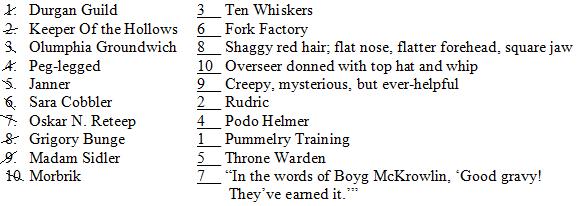
Andrew Peterson must have had similar experiences because they come to us crisp and clear through the pages of his book. The most memorable for me is found in the chapter titled, The Ten Whiskers of Olumphia Groundwich. Allow me to quote at length and see for yourself if my point is not well-taken. The scene is the first day of school, and Nia with her children have just arrived in a carriage at The Guilding Hall and Institute for Hollish Learning. They’ve come to a stop before the stone buildings of the school.

  “Where is everybody?” Leeli asked.
  “In class. Down you go,” Nia said. “We need to speak to the head guildmaster.”
  Janner wanted to ask what a head guildmaster was, but he figured he would know soon enough.
  The three children were as skittish as thwaps in Podo’s garden as Nia marched up the steps and knocked three times on the main door. It swung open immediately, and before them stood a tall, hideous woman in boots and a blue dress. The sleeves were too short, so her knobby wrists and half her forearms stuck out past the frills. Her hair was pulled back in a bun, which made her heavy brow and jaw seem even bigger. She frowned at them with a face that boasted exactly ten curly whiskers: two sprouting from her chin, six on her upper lip, one jutting out from the center of her nose, and one on her left cheek. Janner felt bad for counting them.
  “Oy! Nia Igiby Wingfeather!” the woman barked. Her voice was somehow shrill and husky at the same time. “I was expecting you. Follow.” She spun around and clomped away.
  Nia gave the children a surprised look and led them into the school….
 The ten-whiskered woman stopped and held open a door labeled “Head Guildmadam.” Nia thanked her with a nod and herded the children through. The room was furnished with a small desk and several chairs. A big brown dog snored on a blanket in the corner. Nia gestured for the children to sit and waited until the whiskery dame closed the door and sat at the desk.
  “I figure you don’t remember me,” the woman said with a scowl. “I figure you’re Nia Igiby who up and married a king and left the Hollows. I figure you’re bringing your three pups here for a proper Hollish education. I figure you think you’re somebody now, don’t you?”
  “I do, as a matter of fact,” said Nia. “And I think you’re somebody too.”
  “Oy? Then who, Your Highness? Who is the woman who sits before you?” The woman leaned back in her chair and folded her arms. She stared at Nia and frowned with great effort, which caused the six whiskers on her upper lip and the two on her chin to flick about like the antennae of a bug.
  “Children,” Nia said, still looking the woman in the eye, “I’d like you to meet the guildmadam. Guildmadam Groundwich. I knew her many years ago as Olumphia Groundwich, the Terror of Swainsby Road.”
….
  “Oy!” said Olumphia Groundwich, and she narrowed one eye. “Your mother knows me well. So well, in fact, that she had another name for me. Didn’t you, Nia Igiby? You called me something that no one else dared to call me.”
  “I did,” Nia said after a pause.
  “Tell them.” Mistress Groundwich scratched at a whisker and waved her hand. “Tell them now so we can be done with it.”
  Janner prayed that whatever name Nia called her wouldn’t lead to a fight right there in the guildmadam’s office. He desperately wanted to be on this woman’s good side, though he doubted she had a good side.
  “I called you friend,” Nia said with a smile. “My best friend.”
  “Oy!” Mistress Groundwich said. She leapt to her feet and towered over them. “Oy!” she said again. It startled all three Wingfeather children, who nearly jumped out of their seats.
  Nia embraced Olumphia, who lifted Nia off her feet and made a noise like a growl, at which point the big dog in the corner woke and thumped its tail. Nia looked like one of the children being swung around in one of Podo’s hugs.
  “Nia, my heart is full of joy at seeing you again. I just knew you’d been killed or imprisoned—or—Fanged.” She shot a glance at Kalmar and continued. “But you didn’t! You came back! And with children!”
  “It’s good to see you Olumphia,” Nia laughed. “And head guildmadam! By the hills and the hollows, I’m impressed! You hated school.”
  “I’m as surprised as you are. Never thought anyone would call me Guildmadam. I’m even more surprised that I love it. I always wondered why the Maker made me so tall and lanky, and why he gave me these rogue whiskers. Used to pluck them out every other day, but I found the students more terrified of me with them than without. I don’t have a husband—yet—so what do I care?”
  “Finding a man might be trickier with whiskers,” Nia said.
  “Oy! Hadn’t thought of that.” Olumphia plucked out one of the whiskers. Janner cringed. Olumphia blinked away the water that sprang to her eyes and chuckled. “There! I’ll find me a Hollish prince in no time. The blasted thing will be back by tomorrow evening, though.” Olumphia held up the whisker and inspected it with a frown.

Now, if that doesn’t make you want to get a book from the Wingfeather Saga, in the words of Sapphire Surefoot, “You ain’t in your right mind!”


Get The Monster in the Hollows on amazon.
Series Web Site


Thanks to Rabbit Room Press who kindly provided a copy of the book for review on the CSFF blog tour. The Monster in the Hollows is book three of the Wingfeather Saga.

Sunday, September 18, 2011

CSFF Blog Tour - September, 2011, Day One


Christian Science Fiction and Fantasy Blog Tour (September 2011) - Day One.

The Monster in the Hollows, by Andrew Peterson.


After a long trip across the Dark Sea of Darkness, and the harrowing experiences with the Fangs of Dang, forest-roaming toothy cows, a sea serpent, child slavery in the Fork Factory, and the battle of Kimera, the Igiby family arrives off the shores of Anneira, Nia Igiby’s homeland and its queen. Janner and Kalmer (her sons), Leeli (her daughter), and Podo Helmer (her father and former pirate) arrive with her. Janner had dreamed of living again in Castle Rysen where he was born. But his dreams turn to foolishness. Gnag the Nameless set it afire nine years prior, and it is still burning. 
     Janner was tired of running. He wanted a place to call his own, a place where Fangs didn’t roam, where Stranders didn’t want to cut his throat, and where he and his family could finally be at peace. (p. 9)

The children ask how it is possible that the land was still burning. Nia's answer somberly reveals the gravity of the threat that is pursuing them.
     Nia wiped her eyes. When she spoke, Janner heard the tremble of anger in her voice. “Gnag has hate enough in his heart to melt the very foundations of the castle, down to the bones of the isles itself. He won’t rest until Anniera sinks into the sea.”
    “But why?” Janner asked. “Why does he hate it so much? Who is he, even?”
    “Who knows? When it rages long enough, hate doesn’t need a reason. It burns for the sake of its own heat and devours whatever, or whomever, is set before it. Before the war, rumor came to us about an evil in the mountains—but Throg is a long way from Anniera. We never imagined it would come to us.” Nia closed her eyes. “By the time we realized the Fangs were after Anniera, it was too late. Your father believed the Symian Strait would protect us—or at least give us time to mount a defense.” She shook her head and looked at the children. “The point is, Gnag seemed to come from nowhere, like a crash of lightning. He wanted Anniera. He wanted us dead.” (p. 9,10)

And so, the book begins against the backdrop of an evil entity seeking out their destruction from whom they hope to find haven soon in the Green Hollows, just beyond the burning Anniera. Gnag dwells to the south of the Hollows in the Castle Throg where he “broods on the world’s destruction.” But the Hollows are presumably a sanctuary for several reasons. The folk there are a strong, determined people who have never liked outsiders and have been diligent to keep the Hollows isolated. The land is also protected by a massive, treacherous mountain range that separates it from Gnog's dwelling place; and the deep, twisted forest of Blackwood (whom no one has ever survived) surrounds the Hollows on the east and north. The west is open to the sea. Beside all that, Gnag would not expect to find them in his own back yard—who would be foolish enough to seek refuge there?


Nia is not absolutely certain, but she thinks Gnag made his army of fangs from people. It is probably so. Somewhere in all of the dangers and battles they have been through, Kalmar has fallen victim to this. He was transformed into a Grey Fang, a wolf whose vicious animal appetites overwhelm him at times, though he has learned to control much of it. His eyes are blue, as they were before, but his whole appearance is brutish having a snout, wolfish teeth, and dog-like ears that lay back on his head when he’s sorrowful or embarrassed.

The Green Hollows promises peace and safety, but there is trouble. The Hollow folk hate fangs. Kalmar would have been lynched and murdered if not for Nia’s call for turalay, in which she vouches for Kalmar’s behavior upon pain of the same punishment Kalmar would suffer should he violate his probation.

The family settles in the home of their father’s friend (their father has been lost) and they begin life in the Hollows. It is hard as the children face the brutal tauntings and threats of their schoolmates day in and day out. This becomes quite intense during PT (pummelry training), a class in which Janner and Kalmar are up against those who are at least a year or two older.

There is a monster in the Hollows who is killing livestock, and the citizens are determined to hunt it down and kill it. Who is the monster? Where did he come from, and what is he doing there? What will become of him? The answers to these questions bring the story to an awesome conclusion and set the stage for the final book.

The story and the writing is not like the Chronicles of Narnia, so to compare it to Lewis's classic tales would be absurd. Yet I think it could stand side by side with it. That is, I think the book has the stuff which makes a classic, a classic. Its characters are wonderful and the intertwining of subplots within the main is delightful. The conflict between the Igiby’s and the citizens of the Hollows, especially for the children, brings tension and suspense that keep the story moving, compelling the reader to press on. Humor, villainy, treachery, loyalty, humility, sacrifice and more evoke a wide range of emotion.

I think it is mildly Christian, but I don't think that is a detriment. It does portray the evilness of evil and it reveals to some degree the inner conflicts of conscience that rise in the human heart. It is not a study of these, but it does bring them before the reader. That is all the more a wonder because the young reader's interest is most likely entertainment, and as the story fulfills that element, it does so with a seriousness that is befitting a quality children's story; the kind that a serious Christian writer will strive for.

God is known in the story by the name of Maker, and there is nothing unbiblical that I can detect about the Maker of this fantasy world. The tale does not present a clear message of the Gospel either through pointed declaration or fantastical imagery, so for Christian parents who are looking for such a fantasy, this is not the one. But it is quality literature: wholesome, imaginative, entertaining, and a fine example of the Christian writer who strives, as the image-bearer of God, to reflect the creative attributes of God through his story telling.

Though it is advertised as young adult fantasy (technically age 14 – 21), it is really for middle school readers, roughly age 9 – 12. It is superbly written for that group, and because of that, I think its appeal reaches beyond pre-teens to include young adult and adult.


The Wingfeather saga began in the first volume, On the Edge of the Dark Sea of Darkness (March 18, 2008)


 This was followed by North! Or Be Eaten (August 18, 2009) 


The saga will conclude in the forthcoming novel, The Warden and the Wolf King.

For a drawing of a Grey Fang by Mr. Peterson’s twelve year old son, Aeden, visit his blog, The Crimson Phoenix. You can see another drawing by Justin Gerard at A Fang Of Dang.

Get The Monster in the Hollows on amazon.
Series Web Site


Thanks to Rabbit Room Press who kindly provided a copy of the book for review on the CSFF blog tour. The Monster in the Hollows, by Andrew Peterson, is book three of the Wingfeather Saga.