Tuesday, January 28, 2014

Francis Schaeffer Perspective #4, Art is not Sacred

Perspective #4: The fact that something is a work of art does not make it sacred.

Schaeffer’s point here is that the greatness of the work of art does not validate that world view of the artist. This is a caution against letting the power of the art blind the viewer to any distortion or lack of truthfulness about the way things are as portrayed by the art. I think song can illustrate this point quite well. Song has a powerful impact on the whole makeup of a person. It seems to awaken a sensitivity within the psyche that makes one susceptible to the truth-claims of the song. Song is the combination of musical instrument(s), style, lyrics, and the personal touch of the one(s) who perform. Together, these components can produce something that keeps coming back long after the original hearing of the work. The message of the lyrics play again and again in one’s head, and the music with its melody, harmony, rhythm, and beat reinforces that message. The 1973 rock opera, Jesus Christ Superstar, is a case in point. I have never seen its performance, but I have heard much of the music to know that the Jesus of the opera is a phantom, and a dangerous one who destroys the imagery and truth of the Jesus of the Four Gospels. The tune was catchy and resonated with the lyrics.

Jesus Christ
Jesus Christ
Who are you? What have you sacrificed?
Jesus Christ
Jesus Christ
Who are you? What have you sacrificed?
Jesus Christ
Superstar
Do you think you're what they say you are?
Jesus Christ
Superstar
Do you think you're what they say you are?

Tell me what you think
About your friends at the top
Now who d'you think besides yourself
Was the pick of the crop?
Buddah was he where it's at?
Is he where you are?
Could Muhammmed move a mountain
Or was that just PR?
Did you mean to die like that?
Was that a mistake or
Did you know your messy death
Would be a record breaker?

Contrast that with Man of Sorrows (Philip P. Bliss, 1875):

“Man of Sorrows,” what a name
For the Son of God who came
Ruined sinners to reclaim!
  Hallelujah! what a Savior!

Bearing shame and scoffing rude,
In my place condemned He stood;
Sealed my pardon with His blood;
  Hallelujah! what a Savior!

Guilty, vile, and helpless, we,
Spotless Lamb of God was He;
Full redemption—can it be?
  Hallelujah! what a Savior!

Lifted up was He to die,
“It is finished!” was His cry;
Now in heaven exalted high;
  Hallelujah! what a Savior!

When He comes, our glorious King,
To His kingdom us to bring,
Then anew this song we’ll sing
  Hallelujah! what a Savior!


The psalms and hymns of our Sunday worship are a powerful force, and the church must be ever careful in the theology of its lyrics. There are some hymns, whose theology or egocentricity I find so offensive, I refuse to sing though all others around me participate.

Because the power of the art is so influential in pressing home the world-view it contains, the Christian artist must be careful not to portray inadvertently a perspective that is unbiblical. Christian speculative fiction is especially in danger. Take, for example, a Christ figure. Aslan from the Chronicles of Narnia is such a figure. Is there anything in Aslan’s behavior, speech, mood, or countenance that could portray a Christ that is unbiblical. True, we cannot control the imagination of the reader, but we should take care not to give anything questionable that the imagination can dwell on.


This danger is heightened when the speculative writing is turned into cinema with the wondrous graphics it has today. The imagination is far more passive in taking on the imprint of what is physically seen and heard. That is what I found so disturbing about the Passion of the Christ (2004, directed by Mel Gibson) and it is what I so much appreciated about Ben Hur (1959, directed by William Wyler). In The Passion, the body language, facial expressions, and mood made Christ, the Lamb without blemish, to be no different than any other (sinful) human – there was not the beauty of holiness that marked the Christ of the gospels. In Ben Hur, one never saw the face of Christ. Only once was there a full body shot, and it was from behind when Christ is about to deliver the Sermon on the Mount. A sacred respect about the character and manner of the Messiah was maintained. This is not a small matter when we consider that Christ revealed (exegeted, John 1:18) the Father, and we may assume that he did this in the minutest detail of his speech, facial expressions, and mannerism.

Tuesday, January 21, 2014

Francis Schaeffer's Perspective #3: Continuity with Words and Syntax


Perspective #3. In all forms of writing, both poetry and prose, it makes a tremendous difference whether there is a continuity or a discontinuity with the normal definitions of words in normal syntax. 

In this perspective, Schaeffer uses both literature and painting as examples. It is easier to comprehend his point by first considering a picture. Abstract art will have shapes and colors but does not communicate anything concretely
meaningful. One may look at the art and see something familiar. For example, in this picture, I see a fish feeding. But I also see the mouth and chin of a child; and a giant hair follicle or maybe Larry the Cucumber. In abstract art, one sees intriguing and aesthetically appealing shapes and colors, but they have no meaning except what the observer gives to them, a meaning that comes out of an association between what he sees in the art and what he knows as real and has a meaning which everyone agrees on.

Finnegans Wake, by James Joyce, might be considered abstract art in prose.[1] Jabberwocky, by Lewis Carroll, less so. It is classified as a nonsense poem, but  does have enough sense to it that the killing of a monster is not missed. Its appeal (and clarity also) is heightened when read aloud.
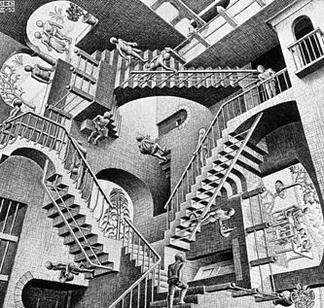
Akin to totally abstract art is art that has identifiable forms in it, but are arranged in such a way that in a casual glance one’s mind does not detect anything amiss; but then, on closer scrutiny, they defy meaning. The graphic art of Maurits Cornelis Escher is an example. In his painting, Relativity (1953), there are a number of stairways and windows that in themselves make perfect sense. But there are people walking up and down them in ways that are impossible and therefore make no sense. For example, the stair at the top of the picture has two persons on it facing the same direction and nearly at the same point, but one is moving up the steps while the other is going down them. We are imaginatively torn as we try to conceive of both true at the same time. We are trying to turn the illogical visuals into something logical, and it gives rise to a frustrating feeling of helplessness because what seems to make sense at first suddenly becomes impossible and thereby has no sense at all. Prose that mimics this kind of art can produce the same frustration.

Schaeffer does not see such art as intrinsically immoral or anti-Christian, but simply that it loses a dimension of communication.[2] Here we are brought back to the point that communication in art is significant, and if so, it increases its value. Communication is important, and it implies a message. It is message that writers of speculative fiction (or any fiction) must give care to. Carelessness or insenstivity in the use of vocabulary, syntax, and grammar will affect the clarity and possibly the meaning of the message. It is not simply words arranged according to rules of grammar and syntax. It is more. Stephen King made the astute observation, “Take any noun. Put it together with any verb, and you have a sentence. It never fails.”[3] The noun and verb follow the rules of grammar and syntax. We may think that all sentences with just a noun and verb say little – except the Johannine observation, Jesus wept. That simple sentence is a jewel whose beauty is magnified by the contextual earth it lies in.

Consider the noun Frog and put it with the verb sings - Frog sings. Does the sentence say something? We know there are no such things as singing frogs, except imaginary ones. A singing frog makes no sense. Are we to say that a story about a singing frog has no value because of the unlikelihood (really, impossibility) of any frog having the ability to sing. Warner Brothers introduced Michigan J Frog in a Looney Tune cartoon on December 31, 1955 entitled, One Froggy Evening. 
If you’re as old as I am, you likely saw it in its debut. The animated feature was a speculative masterpiece, and it did say something – this world is cursed and our best plans go awry. The humor may have dulled that point, but it was there. A singing frog makes no sense, but a story about a singing frog can make a lot of sense. That is why the Chronicles of Narnia makes sense. Talking beavers are illogical, but they can say things that are profoundly true. Speculative fiction uses the illogical, but it does so in such a way that a message is communicated. Speculative fiction is not abstract art, and it should not be art that frustrates because it is imaginatively perplexing.


[1] “The entire book is written in a largely idiosyncratic language, consisting of a mixture of standard English lexical items and neologistic multilingual puns and portmanteau words, which many critics believe attempts to recreate the experience of sleep and dreams. Owing to the work's expansive linguistic experiments, stream of consciousness writing style, literary allusions, free dream associations, and its abandonment of the conventions of plot and character construction, Finnegans Wake remains largely unread by the general public.” Wikipedia Article, FinnegansWake.


[2] Schaeffer writes, “If there is no continuity with the way in which language is normally used, then there is no way for a reader or an audience to know what the author is saying. . . When, therefore, there is no attempt on the part of an artist to use the symbolic vocabulary at all, then communication is impossible here, too. There is then no way for anyone to know what the artist is saying,” 37-38.


[3] Stephen King, On Writing.

Monday, January 13, 2014

Francis Schaeffer’s Perspective #2: The Strength of Art Forms

This is the second article in a series on Francis A. Schaeffer's "Perspectives on Art" in The Christian Imagination, ed. Leland Ryken (Colorado Springs, Colorado: Waterbrook Press, 2002).

Perspective #2. Art forms add strength to the world which shows through, no matter what the world view is or whether the world view is true or false.

Rembrandt’s Carcass of Beef serves to illustrate how the form of art adds strength to the world which it manifests.

“Rembrandt’s art causes us to see the side of beef in a concentrated way, and, speaking for myself, after looking and looking at this picture, I have never been able to look at a side of beef in a butcher shop with the superficiality I did before.” (p 37).

Unfortunately, Schaeffer did not go into a little more detail about the differences in the way he looked at a beef carcass before and after the Rembrandt experience. I think the proverb ‘beauty is in the eye of the beholder’ has some bearing on this. Looking at art is subjective. No two persons will stand in front of the Carcass of Beef and see the same thing. An educated eye will look at art differently from the way it looks at the world which the art reflects. Even the uneducated eye – to see a reproduction of the real world from the hand of the artist alone says something, not only about the artist, but the real world. There is intrigue over why the artist chose the subject and how he transferred what he sees onto the canvas. The final art product carries the full weight of that intrigue.

The art form of fiction shares the nature of the art form of the Rembrandt.  The page is the canvas on which the story is painted and the words are the oils applied with the skillful strokes of grammar and syntax. The writer produces a story that has its ties with the real and ordinary, and places it before the reader ‘in a concentrated way.’  

Schaeffer kept looking and looking at the painting. It had a wondrous appeal. I think, however, the bare fact it was hanging in the Louvre with Rembrandt’s name on it might have raised the appeal several degrees. The works of the masters, or even lesser ones of still lofty reputation, evoke a prejudiced eye. Perhaps the mystique of the artist himself heightens one’s sensitivity to see greatness when it would otherwise be missed. There are artists who are missed even though their works are great because they do not have the celebrity. This holds true for many writers, especially Christian, and to put a finer point on it, Christian speculative fiction writers.[1]

Regardless of the celebrity element, I think we may assume that Rembrandt’s art is capable of having a profound impact in precisely the way Schaeffer hints because it is focused (concentrated). What Schaeffer saw was a result of Rembrandt’s ingenious eye scrutinizing the hanging beef in a way that others do not; perhaps, cannot. Not only his perception, but also his touch makes the difference – a photograph of the same side of beef would not bring out the same subtleties, unless that photo was the art work of a professional photographer whose use of light and dark and angle reveals things that a mere random shot would not.

Schaeffer observes that the side of beef phenomenon holds for literature, that ‘good prose as an art form has something that bad prose does not’ and ‘poetry has something good prose does not.’ The something is the side of beef factor, the thing that grabs one’s attention and increasingly occupies it. I agree in the general direction this line of thought takes. However, I balk at the idea that poetry has something that good prose does not, and I think that much of the reason has to do with me, a left-brained reader. I rarely come away with something moving or epiphanic from poetry. I struggle with Frost and Shakespeare. For me, the poetic form more often than not obscures and confuses. That is my experience and must own up to it. But good prose, ah. Good prose has quite a different effect. It sometimes reaches the intensity of hearing Mozart or Bach or Beethoven – it moves. It opens my imagination to nuances of the truth known and heretofore unknown, and its meaning becomes intellectually and emotionally aesthetic.


Obviously, good prose does far more than bad prose, but it is a point worth making. It is a strong reminder to authors of Christian fiction that their prose needs to be top notch. None of us is a Lewis or a Tolkien when it comes to speculative fiction, regardless of those dastardly over-zealous reviews that compare our work to theirs. I had one refer to The Oerken Leaves (now rewritten as The Oerken Tree) as C. S. Lewis meets Mark Twain. Another compared it to Lewis Carroll’s Alice in Wonderland. Another wrote, ‘If you like Lewis and Tolkien, you’re going to  love this.’ They all make me cringe because it just is not so. Yet, I hope that The Oerken Tree is good prose, and I am not so sure it (or your work) has to be worthy to sit side by side with the Greats in order to be considered top notch. But it surely needs to be several huge steps in that direction. In my opinion, Andrew Peterson’s Wingfeather Saga is there. Polivka’s Blaggard’s Moon should be sitting at least on the same shelf.


There are many Christian young adult fantasy works that have become quite popular in the last decade, and their authors are hailed as great writers. But I think their writings fall in the category of bad prose simply because it is bad art. The good word-artist paints with elegance and beauty. It does not have to be like the masters, but there should be some breath-taking moments in them. Many do not rise much above finger painting and paint by numbers. Few of us bring the reader into a Carcass of Beef experience.


[1] In my opinion, there is not many current day works of this type being produced that is worthy of celebrity fame simply because the writing is only average or slightly better or worse. On the other hand, there are a few who are quite worthy, but the ascription of ‘Christian’ and ‘speculative’ hinder their recognition. It is difficult to gain acknowledgement, as any writer knows, no matter how good the writing. Christian speculative fiction especially. The Christian Science Fiction and Fantasy (CSFF) blog tour has been promoting the genre since 2006. Rebecca Luella Miller administrates the tour. She also administers Speculative Faith, which features articles by authors and agents in the genre. The CSFF blog tour features a novel every month in which the members that participate post a review of the novel or a discussion of something closely related to it. Some provide an interview with the author. Typically, the participating member can receive a courtesy copy of the novel for the review. It is a great way to add to one’s library. The tour lasts three days. The critiques, for the most part, are very insightful and objective. If you think you might want to join the tour, visit here.

Wednesday, January 8, 2014

Reflections on Francis Schaeffer’s Perspectives on Art

Francis A. Schaeffer presents “eleven distinct perspectives[1] from which a Christian can evaluate works of art.” Schaeffer uses literature and painting as primary examples of how his eleven perspectives are used. I want to look at these perspectives in a series of articles and consider their value to the Christian artist, especially for the writer of Christian speculative fiction.

Perspective #1. A work of art has a value in itself. 


Schaeffer ranks this as the most important of all perspectives, and yet I find no clear explanation of what he means. His summarizing statement is tautologous, “Perspective number one is that a work of art is first of all a work of art.” (p 37). The concept of a 'work of art' could be translated, a 'work of beauty,' or a 'work that elicits enjoyment.' Schaeffer writes, "Art is not something we merely analyze or value for its intellectual content. It is something to be enjoyed. The Bible says that the art work in the tabernacle and the temple was for beauty."[2] Given this, Schaeffer places a premium on the aesthetic value of art, making the intellectual content of lesser worth. 


He reinforces this by offering three possible meanings concerning the nature of a work of art the first two of which, in his mind, are invalid. These are (1) the view that art does not say anything and cannot be analyzed, it is simply there; it is art for art’s sake (2) the view that art is the embodiment of a message about the world or man or artist – anything; the fallacy here, in Schaeffer’s thinking, is that this view reduces art to an intellectual statement; (3) the view that the artist’s own world view or view of reality is perceived through a body of work which the artist produces; a body of work is necessary to provide a sufficient sample avoiding a one-sided and limited evaluation.


Given that third point, one wonders if an artist who produces only one work can truly be called an artist, and his work, a work of art. Consider Margaret Mitchell (1900-1949) whose novel, Gone With the Wind, was the only one she wrote. She was a journalist and one might contend that her journalistic writings would offer a greater sample. But they would likely be disqualified seeing that that kind of writing is analytical, informative – in a word, intellectual. Perhaps Gone With the Wind in itself provides ample material (423,575 words[2]) on which to draw some conclusions.

Consider also that if the ascertainment of the artist’s view of reality is a necessary component to evaluating a work of art (as a work of art), where does speculative fiction stand? I cannot be absolutely certain, but I think J K Rowling’s view of reality would not include magic and all the incidentals, though the tale of Harry Potter itself does. The magic and all its attendant paraphernalia is pertinent to the meaning of the story. Assuming that speculative fiction tells a tale which reflects the author’s philosophical outlook (Good always defeats Evil; Love endures; Suffering is good and necessary for Victory), it is particularly problematic. All fiction is make-believe, but speculative fiction is make-believe within make-believe and, therefore, has an added layer of complexity in discerning the author’s (artist’s) view of what this world (cosmos) is all about. To qualify a bit, I am talking about a make-believe that has little to do with our world. An example would be George MacDonald’s (1824-1905) Phantastes, whose message is slippery,[3] I think, if there be an over-arching message at all. It does offer glimpses here and there into MacDonald’s perception of things. For example, Cosmo and the mirror allow MacDonald to give a little of his thought about the significance of art and the imagination.[4]

Rowling’s Harry Potter is not nearly so enigmatic, however. There is not much difference between the wizard world of Harry and the muggle world. The central intelligent beings in both are humans and all the frailties and pleasantries of the one world apply to the other. We ordinary humans can empathize with the extraordinary world of witchcraft and wizardry because at bottom, there’s really not that much difference. The fantastical element of speculative fiction is a perfect fit for mystique and intrigue, which are a part of its beauty and appeal; it elicits enjoyment. The mystique and intrigue of the non-muggle realm provide Rowling with a story-world that likely rivets the attention of the reader and gains his imagination and empathy in a more zealous way, thereby more keenly acclimating that reader to her world-view. That is an important principle for the Christian writer of speculative fiction. You are writing to entertain, but you are also writing to grab the reader and hold him down so that he cannot help but hear what you are saying. This assumes that all our story writing will have a message, which I think is true.

Another thought: Though art should not be reduced to an intellectual statement it cannot be divorced from it either. Is not an author’s world-view and the communication of that through his artwork, intellectual? Not as a formulaic expression, certainly, but it does say something that requires intelligent consideration. In order for it to be intelligible at all, it must be meaningful and capable of interpretation. It must say something intelligent. Given that, it seems the value of all art is necessarily bound to its ability to say something that is intelligible, and therefore has meaning, and meaning implies a message. Art is bound to an inherent message.


Schaeffer does not deny that art has meaning. In fact, he would say it does, but he apparently thinks it is secondary to the art. This is to say that the medium of the message has greater value than the message itself. One may ask, If there is no message, what justifies the medium? Without a message, there is no necessity for a means to convey that message.


The word (message) of God, for example, has a medium: inscripturated human language (in its final form for the present evil age - yes, I am a cessationist). There would be no justification for a Bible if there were no special revelation from God. One could even argue that human language is necessary because it is analogous to divine language (it is a part of our image bearing capacity), and in and of itself is revelatory (points us to God as Language, especially as Language incarnated in the Word - Jesus Christ). Language is a medium necessitated by the need for communicating a message, and most of all, for communicating the truths of God. 


In like fashion, message necessitates art (in whatever form) as a means to communicate that message. I don't think it is the reverse. The message is prior to the art. I think a better point to make is that because message and medium are congruently necessary, reflection should take us into the synergistic relationship between the message and its medium in terms of their power and beauty, and consider both to be of tantamount importance in determining the value of art.


How great is the divide between the art and the world view of the artist? How interdependent are they? Another way to ask this is, What is the coherency between beauty and content, entertainment and message? This has a special bearing on all Christian speculative fiction (or any fiction). The idea that one can write merely for entertainment is questionable with regard to its validity or even its possibility. This does not mean I think entertainment is overrated. Part of the quality of the medium is its ability to hold the reader's attention agreeably, or simply stated, to entertain. It is that 'mystique and intrigue' as entertainment that gives speculative fiction an advantage in its value. But if the medium of art is justified only if there is a message, then we cannot write merely for entertainment's sake. Rather, we must use the entertaining value of speculative fiction to bring home the message. 


[1] Francis Schaeffer, “Perspectives on Art,” in The Christian Imagination, ed. Leland Ryken (Colorado Springs, Colorado: Waterbrook Press, 2002), 35-41.
[2]  ibid., p 35.
[3] Compare J K Rowlings’ Harry Potter and the Order of the Phoenix, the largest in the series, at 257,045 words.
[4] In The Fantastic Imagination, MacDonald poses the question, Must a fairy-tale have meaning? MacDonald answers, “Everyone...who feels the story, will read its meaning after his own nature and development: one man will read one meaning in it, another will read another.” Does this reveal a relativist’s world-view?
[5] Cosmo’s reaction to the mirror: "What a strange thing a mirror is! and what a wondrous affinity exists between it and a man's imagination! For this room of mine, as I behold it in the glass, is the same, and yet not the same. It is not the mere representation of the room I live in, but it looks just as if I were reading about it in a story I like. All its commonness has disappeared. The mirror has lifted it out of the region of fact into the realm of art; and the very representing of it to me has clothed with interest that which was otherwise hard and bare; just as one sees with delight upon the stage the representation of a character from which one would escape in life as from something unendurably wearisome. But is it not rather that art rescues nature from the weary and sated regards of our senses, and the degrading injustice of our anxious everyday life, and, appealing to the imagination, which dwells apart, reveals Nature in some degree as she really is, and as she represents herself to the eye of the child, whose every-day life, fearless and unambitious, meets the true import of the wonder-teeming world around him, and rejoices therein without questioning?” Phantastes, p 78 

Sunday, December 15, 2013

Merlin's Shadow, December 2013 CSFF Blog Tour

Merlin’s Shadow, Book II in the Merlin’s Spiral Series
Blink, 2013
by Robert Treskillard

[December 2013, Christian Science Fiction & Fantasy Blog Tour]

Merlin’s Shadow continues the tale that began in Merlin’s Blade. It recounts the flight of Merlin and a small band pledged to the safety of young Arthur, the rightful heir to the throne of the high king of Briton. Vortigern, a battle chief and grandson of the former high king Vitalinus Gloui, kills Uther, the father of Arthur and high king of Briton. Vortigern, coveting the throne, seeks to destroy all who might challenge his claim. His chief concern is to destroy the child Arthur and those who would protect him. Hence, devoted to Arthur’s protection, Merlin, Natalenya, Colvarth, and Garth steal him away from Vortigern’s evil plans.

Colvarth is a former druid converted to Christianity and once bard of King Uther. Garth is a mischievous orphan who also has some seafaring experience. Natalenya has agreed to marry Merlin, her love. Merlin, horribly scarred in countenance and recently healed from blindness has become aware of his hideous appearance and shrinks back from Natalenya to spare her from his repulsive looks. Natalenya does not care about the scars and is confused and hurt by Merlin’s apparent change of heart. To make matters worse, she has become ill. Her condition worsens as boils gradually cover her body.

Caygek joins the party early on to flee Vortigern, though his loyalties are to himself alone. He is a fili druid, which is a sect of druids who do not offer human sacrifices. As the journey unfolds, the band encounters dangers left and right. There are internal struggles as well as Caygek, suspicious of Christians, is not overly concerned for the safety of Author.

Concurrently, there is the plotting of Morganthu to destroy Merlin and Arthur. Morganthu is an arch Druid, a magician and practitioner of human sacrifice. He uses the magic of an orb to bring about dangerous conditions that threaten to destroy Merlin’s party. Ganieda, the half-sister of Merlin and granddaughter of Morganthu also possesses latent magical abilities and likewise seeks the death of the fleeing band. She is enticed by the Voice which promises her riches and the restoration of her mother who died of an infection caused, in Ganieda’s mind, by Merlin.

The greatest appeal of Merlin’s Shadow is the continual movement between hope and despair in which there are moments so dark one wonders how it could get worse. The story dwells at length on their capture by Picts and the ensuing horrendous treatment at their hand. At one point, they escape and it looks like they will make it free, but they fail and their lot becomes ever grimmer. After a long period of abject drudgery, their condition improves in an unexpected twist which resolves into a sense of well-being for both captor and captive. But this breaks down and and the enduring band is carried forward through yet another unexpected but credible turn.

The tale is precisely the kind one would expect for a saga of this type. It leaves no mistake about who the true God is and the significance of the blood of Christ.  The writing is suitable for a young readership who should enjoy it, especially if the Arthurian genre is what they are looking for. 


Other reviews of Merlin's Shadow for the December 2013 CSFF Blog Tour are here.

Robert Treskillard's Blog


Thanks to Blink for kindly providing a copy of Merlin’s Shadow for review on the December, 2013 Christian Science Fiction and Fantasy Blog Tour.


Monday, December 9, 2013

The Question of Extra-Terrestrial Intelligence Within a Biblical World-View


The SETI Institute (Search for Extra-Terrestrial Intelligence; SETI rhymes with Betty) is an intriguing idea. It is based on the notion that the mathematical probability of intelligent life existing elsewhere in the universe is high enough that such a search is justified. The question of whether we have the technology to discover such life is another matter. As it stands now, our technology allows us only to detect that life (if it exists) through the reception of radio waves:

Within the limits of our existing technology, any practical search for distant intelligent life must necessarily be a search for some manifestation of a distant technology. In each of its last four decadal reviews, the National Research Council has emphasized the relevance and importance of searching for evidence of the electromagnetic signature of distant civilizations. -- SETI Institute

The Drake Equation, developed by Frank Drake, which he presented in 1961, serves as a benchmark formula to estimate the number of likely intelligent civilizations that might be out there. For those who are mathematically inclined the equation is in this footnote.[1]

File:Frank Drake - edit.jpg

Having written Broca’s Brain in 1974, Carl Sagan would have been aware of the equation, and I assume his remarks in that book about the calculated figure are based on it:

File:Carl Sagan Planetary Society.JPG
When we do the arithmetic, the sorts of numbers we come up with are, characteristically, around a million technical civilizations [in our galaxy]. A million civilizations is a breathtakingly large number, and it is exhilarating to imagine the diversity, lifestyles, and commerce of those million worlds. But the Milky Way Galaxy contains some 250 billion stars, and even with a million civilizations, less than one star in 200,000 would have a planet inhabited by an advanced civilization. -- Broca’s Brain, p 315.

As a Christian, I am intrigued by the notion of extra-terrestrial intelligence. Not dog-like or chimpanzee-like intelligence, but the kind that one would find in a civilization that has language and technology. Sagan and SETI contemplate the existence of such civilizations based on an evolutionary world-view:

How many planets exists that might support life? Indeed, what is required for life to exist? How does life start? How does it evolve, and what fabulous creatures can evolution produce? How often do intelligent creatures appear in the giant tapestry of life? It is exactly these questions that are being addressed by the scientists of the Carl Sagan Center for the Study of Life in the Universe.

The estimated appearance of such life is grounded in an evolutionary colored formula of probability that by necessity must ignore the real Origin of Life, i.e., the very first moment that anything existed in which life could supposedly evolve. The probability is exactly zero seeing that the Origin we are talking about here is the coming into existence of something out of nothing, which, logically and naturally speaking, is impossible. So the Drake Equation and Sagan’s estimates assume the existence of something already there. They also assume that life arises, evolves, and reaches a point in which it becomes self-aware, intelligent, and technologically savvy.

Setting aside the question of whether it is legitimate to ignore such a profound and basic matter as the Origin of Life, and whether the evolutionary qualifications of the formula are sound, the idea of probability is striking. From a Christian world-view, probability is something that is built into the nature of things. The probability of flipping a coin with the predicted result of tails coming up one hundred times in a row is the same as any other pattern for a hundred flips. It is a mathematical phenomenon and mathematics are as much the creation of God as anything else. I suspect that the probability of tails showing up a hundred times in a row just one time over a million tries could be determined. Likewise, over ten million, or a hundred million, or two-hundred million. In each case, the probability would be higher than before. If we consider these probabilities Biblically, they are there because God built them into the creation. To refine the point, they are there for a purpose, for God does not do anything that does not have a purpose to accomplish all his holy will (Eph 1:11) and to bring glory to him in the end (John 11:4; 1 Cor 10:31; 2 Cor 1:20).

There is absolutely nothing in the Bible that speaks of or even hints that there are extra-terrestrials out there. One far-fetched interpretation, which I heard once, involved the parable of the lost sheep. It took the ninety-nine sheep to represent this world and the one sheep that was lost to represent another world. It is loaded with problems of internal consistency not to mention complete ignorance of the textual and theological context of the parable.

If I were to look for a hint that God might have extra-terrestrials in mind, I would look to what the Scriptures say about the eschatological future, which is little in comparison to what it says of the pre-eschatological present. The fact that saints shall reign with Christ (2 Tim 2:12; Rev 22:5) might imply a cosmic reign that will take place in galaxies throughout the universe. Imagine having a whole galaxy to rule! For arguments sake, let’s assume that our reign will involve galactic oversight. Would the intelligent beings in our galaxy be new with the new creation (2 Peter 3:10-13)? That is, does their existence depend on the renewal of the creation? If so, they do not exist now. We know that they would be righteous and holy servants of God since no sin will exist then. However, looking to the future does not help us with the present except to say that if they might exist then (because God deems it to be good), they might exist now (for the same reason).

If we just look at the way God does things in terms of probability, it is a legitimate question to ask how probable it is that God has created other intelligent civilizations out there. I think the answer would have to be that it is probable. Perhaps, highly probable. If the Drake Equation with all of its added evolutionary baggage finds it probable for one star in two-hundred thousand in our galaxy alone to be suitable for life (meaning life as we know it on our planet), what are the odds if we take that baggage away?

Assuming an unencumbered Drake’s Equation has merit and validity, we are faced with an even bigger question. The creation in its present state is groaning under the curse of Adam’s sin and is awaiting the day of redemption – the revelation of the saints in glory (Rom 8:18-22). Assuming there are intelligent civilizations out there, they are civilizations that exist in a cursed universe. The bigger question is this, Are they God-lovers or God-haters? If they have been made in God’s image as we are, they would be under a divinely stipulated set of commandments as the human race is. Presumably those commandments are similar to our ten commandments. Idolatry, murder, lying, cheating, coveting and such would definitely be off the table because they are inherently contrary to the nature of God. The Sabbath? Perhaps not a requirement but something like it. Have the extra-terrestrials kept those commandments or broken them? If they have kept them, what is it like for unfallen image-bearers to live in a cursed creation? If they have broken them, what hope do they have for redemption?

All of this is speculative. These are not the kinds of questions that theologians are occupied with (thankfully). But they are the kind that Christian writers of speculative fiction are. They open up a wealth of fiction opportunities, because they are questions that reside within a legitimate Biblical world-view. And because of that, such speculative fiction can bring out profound truths about God and his redemptive purposes in Christ.


[1] N = R* • fp • ne • fl • fi • fc • L
Where,
N = The number of civilizations in The Milky Way Galaxy whose electromagnetic emissions are detectable.
R* =The rate of formation of stars suitable for the development of intelligent life.
fp = The fraction of those stars with planetary systems.
ne = The number of planets, per solar system, with an environment suitable for life.
fl = The fraction of suitable planets on which life actually appears.
fi = The fraction of life bearing planets on which intelligent life emerges.
fc = The fraction of civilizations that develop a technology that releases detectable signs of their existence into space.
L = The length of time such civilizations release detectable signals into space.

Tuesday, December 3, 2013

Dialogue Attributions: Stephen King, J K Rowling, and My Two Cents

"I'm convinced fear is at the root of most bad writing. If one is writing for one's own pleasure, that fear may be mild--timidity is the word I've used here. If, however, one is working under deadline--a school paper, a newspaper article, the SAT writing sample--that fear may be intense. Dumbo got airborne with the help of a magic feather; you may feel the urge to grasp a passive verb or one of those nasty adverbs for the same reason. Just remember before you do that Dumbo didn't need the feather; the magic was in him."
-- Stephen King, On Writing, p 127.

Interestingly, J. K. Rowling is well known for adverbial dialogue attributions and has been criticized for it. But that didn't keep King from including the first three Harry Potter novels on his list of 'best books I've read over the last three or four years" [1996-2000].

I don't think dialogue attribution is always the nasty varmint it's made out to be. The only ones that really care about them, because they have to, are editors, contest judges, and teachers.

To be clear, however, I've never seen anything like these in Rowling's writing:

"Give it up, Boswell," he spat menacingly.
"Don't leave me," she begged grovelingly.
"I see the light!" he erupted joyously.
 
Makes you cringe doesn't it. By God's grace, they will never appear in my writing. Nor anything close to them. Yet, I think one might get away with them. It depends on the readership. Juvenile readers may think they're cool. Pulp fiction readers wouldn't flinch at all, I don't think. But we Christian writers are writing elegantly, aren't we, and this falls a mile below elegance. These are worse case examples, yet they make a vivid point about how low one could go to add that extra little touch that Stephen King warns against.
 
Here is how I think these might be acceptable:
 
(1) "Give it up, Boswell," he said darkly.
(2) "Don't leave me," she pleaded, tears emerging.
(3) "I see the light!" he bellowed.
 
The purist would say for (1) that if the context sets the mood well enough, the adverb 'darkly' is unnecessary. That has never been true for me. As dark and somber and tense the setting might be I don't get the same feel without the adverb as with it.
 
Admittedly, for (2), an adverb is not used; rather an adverbial phrase which assumes that tears have not started to flow but are anticipated. Caution though; if there is no anticipation of tears, the tag would feel out of place.
 
For (3), the purist would have to relent that something stronger than the word 'said' is necessary; but he would certainly be right in insisting that adding an adverb would be just plain wrong. This attribution is forceful enough on its own; an adverb would be redundant and cumbersome.